
Showing posts with label wendy welch. Show all posts
Showing posts with label wendy welch. Show all posts
Thursday, April 26, 2018


Monday, May 9, 2016
Sunday, March 13, 2016
Wednesday, September 30, 2015
Monday, July 27, 2015
Saturday, January 10, 2015
Reality Follies at Open Space by Philip Willey. Jan. 2015
The first show of 2015 at Open Space features five artists and two curators, Lynda Gammon and Wendy Welch. The catalogue begins with an observation…..
“We live in an image-world. Selfies on Facebook, instant sharing on Instagram, and photo albums on Flickr, all demonstrate our intense desire to re-present our world. Through the practice of painting, the artists in this exhibition, each in their own way, are re-presenting and interrogating the meaning of representation, and in turn, questioning our ways of perceiving reality.”
Jeremy Herndl focuses on landscape. His paintings give the sense of being created outdoors in an attempt to catch scenes glimpsed fleetingly. He is more concerned with the overall impression than with individual details and his work often borders on abstraction.

Rick Leong translates the visual language of Asian landscapes to contemporary Western formats.

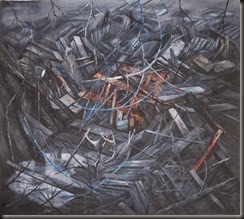
Jeroen Witvliet’s paintings look at first glance like heaps of smoldering debris interwoven with branches, antlers etc. He’s probably best known for his black and white work but the pieces at Open Space contain muted colour.
Neil McClelland’s paintings of bathers manifest a Cezanne- like interest in form and planes.

Some may remember Todd Lambeth’s paintings of cats at Deluge Gallery. This new series of paintings shows the backside of paintings. It makes for a somewhat coy statement. Not as powerful as the NYPD turning their backs on the mayor perhaps but it hints at some kind of negation or reluctance to specify the content.We have to imagine it.

This being a group show one looks inevitably for associative elements. So what is the common thread here?
They are all painters. And they all deal with representation in the sense that they use recognizable subject matter, as distinct from abstraction which so often relies on titles for reference points. Beyond that there is an unrestricted plein air feeling to the whole show that suggests an empathy for landscape. There is a perceptive essay by Wendy Welch in the catalogue which explains the concept behind the show…
‘Realities Follies questions how the real can be represented in painting through form and process….Reality in a painting can move from objective images of the world to subjective constructs based on the physical experience of creating the work’.
Not to downplay Welch’s thesis but the same can be said of sculpture, photography and even conceptual art. All art forms in fact can and do go beyond representation. Still in this context she is making a case for painters having more physical control of the reality they choose to represent as opposed to the reality of photography. She admits a consensus on what reality is might be hard to come by but she sees painters ‘letting imagination, memory and the painting process itself direct the end result’.
She describes Herndl’s paintings for instance as a kind of shorthand, a meditation on light, forms and colour whereas Leong creates a fantastical reality rom hybrid sources, Lambeth questions the nature of painting, McClelland takes a historical approach, and Witvliet speaks of survival.
Welch expands on these ideas in another essay on the VISA website.* In this essay she talks about a rebirth of painting. (Some among us would say it never died but that’s a separate debate). In an age of saturation by photo-based images Welch considers painting as relevant as it ever was. Perhaps more so.
The curators want to inspire us to make sense of our own reality. Have they been successful? The show runs until Feb 21st. so go to Open Space and decide for yourself.
The artists and curators will meet in a panel discussion on Saturday, January 17 at 2:00 pm. at Open Space.
· http://tinyurl.com/n7pdf4f
“We live in an image-world. Selfies on Facebook, instant sharing on Instagram, and photo albums on Flickr, all demonstrate our intense desire to re-present our world. Through the practice of painting, the artists in this exhibition, each in their own way, are re-presenting and interrogating the meaning of representation, and in turn, questioning our ways of perceiving reality.”
Jeremy Herndl focuses on landscape. His paintings give the sense of being created outdoors in an attempt to catch scenes glimpsed fleetingly. He is more concerned with the overall impression than with individual details and his work often borders on abstraction.

Rick Leong translates the visual language of Asian landscapes to contemporary Western formats.

Jeroen Witvliet’s paintings look at first glance like heaps of smoldering debris interwoven with branches, antlers etc. He’s probably best known for his black and white work but the pieces at Open Space contain muted colour.

Neil McClelland’s paintings of bathers manifest a Cezanne- like interest in form and planes.

Some may remember Todd Lambeth’s paintings of cats at Deluge Gallery. This new series of paintings shows the backside of paintings. It makes for a somewhat coy statement. Not as powerful as the NYPD turning their backs on the mayor perhaps but it hints at some kind of negation or reluctance to specify the content.We have to imagine it.

This being a group show one looks inevitably for associative elements. So what is the common thread here?
They are all painters. And they all deal with representation in the sense that they use recognizable subject matter, as distinct from abstraction which so often relies on titles for reference points. Beyond that there is an unrestricted plein air feeling to the whole show that suggests an empathy for landscape. There is a perceptive essay by Wendy Welch in the catalogue which explains the concept behind the show…
‘Realities Follies questions how the real can be represented in painting through form and process….Reality in a painting can move from objective images of the world to subjective constructs based on the physical experience of creating the work’.
Not to downplay Welch’s thesis but the same can be said of sculpture, photography and even conceptual art. All art forms in fact can and do go beyond representation. Still in this context she is making a case for painters having more physical control of the reality they choose to represent as opposed to the reality of photography. She admits a consensus on what reality is might be hard to come by but she sees painters ‘letting imagination, memory and the painting process itself direct the end result’.
She describes Herndl’s paintings for instance as a kind of shorthand, a meditation on light, forms and colour whereas Leong creates a fantastical reality rom hybrid sources, Lambeth questions the nature of painting, McClelland takes a historical approach, and Witvliet speaks of survival.
Welch expands on these ideas in another essay on the VISA website.* In this essay she talks about a rebirth of painting. (Some among us would say it never died but that’s a separate debate). In an age of saturation by photo-based images Welch considers painting as relevant as it ever was. Perhaps more so.
The curators want to inspire us to make sense of our own reality. Have they been successful? The show runs until Feb 21st. so go to Open Space and decide for yourself.
The artists and curators will meet in a panel discussion on Saturday, January 17 at 2:00 pm. at Open Space.
· http://tinyurl.com/n7pdf4f
Friday, January 9, 2015

Monday, June 3, 2013
The Poetic vs The Literal by Wendy Welch
Once
when looking for the poetry section in a Vancouver bookstore, I was
told by the owner 'poetry is being phased out'. Every now and then I get
the feeling that contemporary art is being phased out in Victoria. Most
cities of comparable size to Victoria have a downtown municipal art
gallery; instead our gallery (the AGGV) is a fair distance from the city
core. The AGGV also seems to be allocating much less space and time for
contemporary art shows compared to ten years ago. Most of our local
publications such as the Times Colonist, Victoria News and Monday
Magazine rarely, if at all, cover contemporary visual art. And now with
the Robert Bateman Centre being established downtown, my suspicions seemed to be confirmed.
While I very much appreciate and admire Bateman for his
dedication to the environment, I have issues with the negative way he
speaks about contemporary art. At a recent talk at UVic he showed images
of work from the Museum of Modern Art
in New York as examples of art showing 'lack of talent'. In full
disclosure, I did not hear the talk myself; my knowledge of what was
said comes from talking to others who were there and from reading a
synopsis: The Ring,
We have hosted dozens of artist talks at VISA and never once have I
ever experienced an artist disparaging another artist or artwork during
their presentation. I imagine if Bateman lived in the 19th century he
would have criticized van Gogh and Matisse for their lack of
representational skills.
People who criticize Bateman in any way get called 'art
snobs' and Bateman himself refers to the contemporary art world as 'the
priesthood'. It is possible that the reason his work is not in the
collection of any major Canadian galleries such as the National Gallery,
the AGO or the VAG, doesn't actually have to do with art snobbery. I
might suggest that it has to do with his very literal and
straightforward representation of the subject matter. I imagine he would
share some sympathies with the bookstore owner who was aiming to phase
out poetry. If being an 'art snob' means the preference for poetic
interpretation over literal representation, then I suppose I must be
guilty.
Thinking of Bateman and contemporary art made me start
thinking about artists who use animals as subjects or content in their
work. My favourite example of contemporary animal drawings is the work
of Kiki Smith. Other examples that span through the last century include Giocoma Balla with his 1912 Futurist painting called 'Dynamism of a Dog on a Leash'; Morris Graves and Leonard Baskin have done drawing and paintings of birds. Leonard Baskin has illustrated a book of Ted Hughes' poetry called 'The Crows'. Franz Marc was a German Expressionist painter who used horses as a subject for many of his paintings. Susan Rothenberg, a New York-based artist became renown in the late 1970's for her paintings of horses. Los Angeles artist Laura Owens makes quirky fantastical fairy tale animals. Elizabeth Blackadder is
a Scottish artist who often includes cats in her slightly idiosyncratic
still life watercolours. A local Victoria artist who creates
interesting compositions with animals is Tamara Bond.
Bateman talks about his work as his way of acknowledging the
natural world; I certainly understand and respect this desire. Biology
classes were always my favourite because I got to sit down and do close
observation drawings, and still today I love to draw a plant as a way of
stopping time and paying attention to details that normally go
unnoticed. It is exciting to use drawing and painting to see the
complexities of our natural world. However I do think compelling art has
nothing to do with realism or abstraction, and nothing to do with
whether or not the image is accurately or awkwardly rendered. I would
say that art of significance makes us ask questions. In Vernon Fisher's
bird painting below we find ourselves wondering if the bird is still or
moving, is it taking off or landing? Was the artist inspired by an
illustration from a zoology book or was this a bird he saw in his own
backyard? What effect does the empty space have? What about the black
background filled with erasure marks? How does this add to the content
of the work? Or take Durer's iconic Hare drawing: while this work appears to be a very realistic rendering of an
animal, the artist has taken liberties and exaggerated the texture of
the hare in terms of how we would normally see it with our own eyes.
Durer shows us more than we can see. The image asks questions of the
viewer. Why has the artist put the hare on this angle? Where is the
viewer? Are we on top of the hare looking down on him? The hare seems in
repose yet we know he is keenly aware because of the slight shift in
his ears. There's much going on in this simple work.
To encourage a balance of looking at diverse kinds of art, I suggest that on your way to the Robert Bateman Centre, you stop into Deluge Contemporary Art and check out Todd Lambeth's painting of cats and you can make your own judgements and observations with regards to these two divergent ways of portraying animals. Lambeth's exhibition is up until June 15.

Friday, September 21, 2012
V.I.S.A. Faculty exhibition at the Slide Room Gallery

Vancouver Island School of Art - Faculty Exhibition
Work by Rachel Hellner, Jeremy Herndl, Danielle Hogan, Todd Lambeth, John Luna, Tracey Nelson, Tara Nicholson, Jenn Robins, Xane St Phillip, Marie Ulber, Wendy Welch and Jeroen Witvliet.
Opening Reception : Sept. 21, 2012 @ 7:30 pm
The Slide Room Gallery
2549 Quadra St.
Exhibit ends Nov. 5, 2012
Tuesday, July 26, 2011
"An afternoon at Deep Cove" by Philip Willey
Mary and Moses….religious connotations? Well maybe. Certainly nothing too dogmatic. Perhaps spiritual is a better, broader, more inclusive word….maybe you would even call it Pantheistic if you were lucky enough to find yourself in Mary’s forest garden this weekend. Mary was Mary Martin, the owner of the property, recently deceased. Moses from the name of the street. Christine Clark, currently resident, turned the place into a sculpture garden.

Some Amish Kapoor blue objects in the grass by Tyler Hodgins suggested a tent city seen from a plane window. Todd Lambeth’s row of stakes, coloured from black to white provided a sharp counterpoint to the lush abandon of the natural surroundings.

 Christine Clark’s giant cabbage surprised everyone.
 So did the readymade oil tank. Not sure who should get the credit for that…
 We stopped for wine. And a chat. And more wine. Then it was back into the garden. Some of us were stumbling a bit at this point but we pressed on. And there to our amazement was a Luna/Welch installation….
 A classroom in the woods. You don’t see that every day. Elyse Portal had attached some clay pipe-like things in the trees. Bizarre at first sight but we took it in our stride.

 I’m told Michael Jess buried a time capsule as part of a performance. We were shown the spot. The earth had clearly been disturbed. And suddenly there we were back at the house. Everybody agreed it had been a most enjoyable tour.
One wonders what timid forest creatures would make of it all. (I know Christine has a rodent problem so I must be careful here) Do they come out at night and stand in awe of human accomplishment? Or do they see these creations as convenient places to nest? Bela may well know the answer but he isn’t telling.
 It was all quite magical and I hope I haven’t left anybody out. The Spirit of place was everywhere….that indefinable something that is so much a part of the Pacific Northwest. Definitely a spiritual experience. It wouldn’t have been a big surprise to see a troupe of playful fauns emerging from the bush.

Eight artists had accepted her invitation to create al fresco. Inspired by the beauty of the location they rose to the challenge and produced some remarkable responses. Debora Alanna’s white assemblages looked perfect in the pond…like an opalescent Monet…the sunlight helped.

Some Amish Kapoor blue objects in the grass by Tyler Hodgins suggested a tent city seen from a plane window. Todd Lambeth’s row of stakes, coloured from black to white provided a sharp counterpoint to the lush abandon of the natural surroundings.


And there on some steps leading down to the beach Troi Donnelly had juxtaposed some bright plastic objects. Twisted words on closer inspection. Nobody questioned it. We sensed instinctively it was all part of the great cosmic scheme.

One wonders what timid forest creatures would make of it all. (I know Christine has a rodent problem so I must be careful here) Do they come out at night and stand in awe of human accomplishment? Or do they see these creations as convenient places to nest? Bela may well know the answer but he isn’t telling.


The Mary and Moses Sculpture Garden Show
July 22,23 & 24, 2011
Moses Pt. Rd., North Saanich
Victoria, BC Canada
Thursday, July 21, 2011
Christine Clark,Tyler Hodgins,Wendy Welch,Sarah Stein and more at The Mary and Moses Sculpture Garden Show
The Mary and Moses
Sculpture Garden Show
Sculpture Garden Show

artists:
Christine Clark
Debora Alanna
Elyse Portal
Emilio Portal
John Luna
Marlene Jess
Michael Jess
Todd Lambeth
Troi Donnelly
Tyler Hodgins
Sarah Stein
Wendy Welch
Christine Clark
Debora Alanna
Elyse Portal
Emilio Portal
John Luna
Marlene Jess
Michael Jess
Todd Lambeth
Troi Donnelly
Tyler Hodgins
Sarah Stein
Wendy Welch
Friday, July 22, 6-10pm
Saturday and Sunday
July 23 and 24th
July 23 and 24th
1-4:30pm
389 Moses Pt. Rd., North Saanich
contact Christine @ 250-656-7165 for more info or directions.
Wednesday, April 21, 2010
Wendy Welch for exhibit-v !
We are super happy to announce that Wendy Welch will be our contributor to the new section WRITE-UPS !
Wendy’s practice includes sculpture, painting, and drawing, art writing and curatorial work. Wendy has taught at the Victoria College of Art, the University of Victoria and Camosun College. Wendy has recently had a solo exhibition at Open Space and the Southern Alberta Art Gallery. Wendy is founder and director of the Vancouver Island School of Art.
MFA, University of Victoria
BFA, Concordia University
Subscribe to:
Posts (Atom)