‘The Birthday Party Paintings’
3-19 October 2014
Christine Clark’s latest work is a series of 12 x 12’ oil
paintings collectively titled ‘The Birthday Party Paintings’. These paintings are expectantly familiar to
all that have celebrated a birthday.
They are attentive and considerate to their origins, the photographed
family album. Clark has painted more, exposed more than any faithful family
photo can reveal. She has a facility to
paint what is not easily described in words or can be ascertained within a
casually photographed image. She can paint tenderness, transitions, perplexity,
and raw tests of relations, the mystification that often encompass childhood
feelings. Her paintings celebrate the
prosaic as important means to substantiate childhood experiences that are
implicit, personal and merged into the blocks of time softened by memory. Clark brings out eclipsed revelations during
birthday parties chronicled within 17 square 70s genre paintings.
‘Happy Birthday to you.’ [1]
Artemis seems to be responsible for the round shape of honey cakes
alit with candles to evoke her being goddess of the moon, wishes granted when
blown [2]
although some think the Western traditions follow the German Kinderfest (but
where did that come from?). The first known recording of birthdays is on the
Rosetta stone where documentation exists of the celebration of Ptolemy V
Epiphanes’ (reigned 204–181 BC) birthday (and coronation) in exchange for
concessions to priests [3]
and his subjects – gifts to temples, damming the Nile for farmers. [4]
Through time, by the 18th century aristocracy was able to afford
cake, but the middle classes eventually adopted the tradition of celebrating
birthdays. It seems that so long as there have been calendars, birthdays have
been celebrated to commemorate birthdays. Arturo Ricci (Italian), Fredrick
Daniel Hardy (English), Walter Osborne (Irish) and Ludwig Knaus (German)
painted versions of birthday parties at the turn of the last century – when
celebrating a birthday with a party seemed to become an international
phenomenon in this cake and candles tradition. Birthdays became feasts to
celebrate children royally.
The birthday party has been around, as a cultural institution for
some time. Photography as a means to document celebrations, substantial events
and commonplace circumstances seemed to supplant paintings in the 20th century.
By mid 20th century North America everybody seemed to celebrate, at least a
child’s birthday, with cake and candles, taking snaps to mark the occasion.
Clark’s work is a document to her memories of her familial celebrations
recorded through family photographs, painted to accentuate and respond, counter
the photographed images, marking the occasions with her bringing forward her
understanding and feelings that are unique to painting, visions of time and place through her
observations and experiences.
Hung as the gallery’s horizon line, Clark’s work encircles us with
circa 1970s birthday party views.
Birthdays past present as square instruments draw us through conclusive
evidence of regularity, earnestly considered slices of moments of childhoods
lived. Clark’s series are multiples of remembrances once captured on film for
posterity. Clark painted the photographed images allowing painterly responses
that enables a translation of the photo within painted portraits, the
intersection of past with the present. Her horizon of works ensnare frank
childhood celebratory events common to many North Americans, the birthday
party. She paints familiar interiors, captive familial gatherings, enclosed
spaces framing seasons of weather. She
reiterates a marginal shufti of a load bearing blue truck cornered in windows.
Cleverly rendered recurring corners of middle income family bungalows are
painted in various views. Sometimes, partial or closed curtains of vertical bands
giving structure, stabilizing the agitating affect of smudged or masked faces
that startle and perturb. Horizontal versions of golden Greco-Roman fabric
patterns appear in separate works, rumpled to allow doubt, misgiving,
redirecting our view. Foreground fabric bands effect our consideration of
figure/figures within painting squares to readdress the importune agitation of
who, when and where, an unspecified placement somewhere in time, an
undistinguished location.

Ambiguity becomes a secret. Why? What is it we must not know? We
as viewers become accomplices in the covert scene because we have seen it, and
we cannot tell or explain because we do not have enough information to
explicate. Clark involves us as abettors, and leaves us unapologetically
perplexed, a participant in the awry portraits because we are a witness to some
indefinite cover-up or smeared childhood experience. The masked and smudged
paintings are about the assumptions we make, the masquerade of pretence when
guess becomes adopted responsibility.


Clark tests angles, viewpoints (hers and ours) through positions
of cakes and children’s standpoints within kitchen approaches, dining room
table shapes, aperture treatments and windowpane scrutiny. She paints sets of
decorated birthday party rooms that allow emotive content to be showcased.
Clark expounds, elaborates and accentuates scenarios with period colours and
party accoutrements, undoubtedly gleaned from the original photographs. Clark
has the facility for heightening the seemingly banal to generate a disposition
depiction within individual works beyond ambiance without being coy or obvious.
Tilts of lit candles, cake decoration distinction, fabric and pattern
deviation, groupings of kids stage-manage, allowing direction and control that
may appear casual or incidental. Her arrangements and embellishments angle our
perception of the content of the scenes. Clark’s stratagems encourage
reflection, unhurried purposeful reflection. ‘The Birthday Party Paintings’ are
replete with ideas.
Clark directs us to think about how tradition is coherent. She
shows us how regularity is valuable as a means to collective extemporization.
Although the birthday party is a time honoured tradition, reliably a good time
to be had, there is always a degree of excitement and the possibility of
commotion, consternation because children are unpredictable. Well behaved
adults will be on the sidelines, like the inactive typewriters Clark paints,
quiescent on bureaus, their lives on hold for the occasion. Clark substantiates
the timelessness of ritual through her adherence to the birthday party theme.
She paints the basis of culturally unequivocal need for and a kind of
validation of identity through the birthday party celebration. Clark honours
childhood memory. She respects the birthday party as a gift from elders to
allow a communal experience. She provides evidence of and expounds on childhood
through the wide spectrum between casual and uncomfortable impressions
throughout her birthday party experiences. Clark’s ‘The Birthday Party
Paintings’ are complex, intricately painted encapsulations of substantial
provocation, inviting with unguarded reveals of qualities of innocence.


‘It's my party, and I'll cry if I want to
Cry if I want to, cry if I want to
You would cry too if it happened to you’
Innocence is masked in several of Clarks works. Clark’s painted
tears on masks may or may not be real. A child without a mask painted similarly
sad to a masked child with tears on her mask shows Clark’s ability to challenge
ambiguity, to illustrate the multiplicity of childhood innocence with its pain
exposed and the tease of the median between distress and guarded emotional
ranges. Pain is distinguished as a justified act of contrition. Sorrow is
acceptable.
Clark generates a range of significant of feelings through her
painted environments. Her explorations of veracity are exposed through the
square shapes of this body of work. She multiplies the range, viewpoints of
ideas within her paintings by rendering scenes in slightly differentiated
perspectives. Within the square, she is able to formulate quadrilateral spaces
to test conformity. There is a sense of openness, directness in this work.
Clark is adept at delving into and can uncannily elucidate the diverse breadth
of girlhood dispositions through her paintings.

An older child in long maroon floral dress sits alone in a half
back vanity chair that truncates a dark blue swivel seat which seems to be
upholstered as if it belonged in a car. Curtains drape like hair just brushed
in readiness. The girl seems tentative, pensive. Has she isolated herself or is
she abandoned, stranded, deserted by others at the party? That’s how it is with
change – one finds oneself alone, because being solitary is necessary for
change. The room is muted, spare, frugal.
She seems oblivious to the waiting driver of the pretty sky blue truck,
driver straining to see, maybe, a memory of security. No one will see the
transformation from girlhood to woman until it is a fact. The girl seems
waiting, too - waiting for time to pass, waiting for adulthood. Deep brown
ground weights the scene. Yellow and white bungalow paint is brighter, more
spruce than the anteroom.
Clark paints a significant version of vanity, how pride, self
worth is required to make change. The make-up chair is separate from the
vanity, or dressing table. She painted the segregation of the ideal, societal
mirroring allowing the girl comfort, calm, self containment. Waiting is part of
the process of the inherent transition from girlhood to adulthood. Although
Clark allows the girl to sit in the vanity chair, there is no futility of an
idyllic existence present. The smart house and appealing truck in the window
view is suggestive of thoughts about model existences, future possibilities as
one might have as goals or outlying hopes. The child sits in a primping seat,
but is painted straightforwardly candid, sincere, and ingenuous. She is allowed
to feel special for the duration of her transit. Clark’s coinciding overlap of
the upholstered swivel seat is self-consciousness, prickly to the viewer as if
one might feel if they sat with bare legs on the dark mystery of chair’s
worsted twill, the unknown place. The absence of an occupant, its proximity to
the girl suggests that the car chair might be the next chair she will occupy,
that adulthood is close. Transitioning to the sober chair seems a large,
ominous transition. There is no impediment – Clark paints room to / for change.

Several of Clark’s works are painted with a dark shadowy
dead-colour used in early Flemish painting process [5] -
an underpainting of murky black paint without further paint treatment, leaving
us without chromatic subtlety one might experience if subsequent top layers of
paint were employed. Clark paints a demanding picture plane. Her biased,
subjective scheme provokes. At first, these vistas seem to be night shade
views. However, the blackened space becomes an indication of something of
consequence or calamitous occurring in the foreground redirected by the dark. A
boy looks at the viewer, as if caught by an inadvertent voyeur. A girl is the
conduit for provocation. Clark skilfully paints the presence felt by girls in
her work with emotional bluntness. She luminously captures the tenderness of
realization, the discomfort, the epiphanies, the meaness girls exude. Her
portrayals render unutterable subtlety and disquiet.

Clark’s family photo collection inspired paintings reiterate
square portraits reminiscent of Polaroid or SX70 formats. The washed blackened
ground in several works, obliterating any view outside a window or other rooms,
framing, bringing forward the interior seen, eliminating the background and
minimizing the middle ground (curtains, adjacent walls, incidentals on a table)
is also reminiscent of Kazimir Malevich’s black and his other colours of
squares. Malevich described precepts of ‘Suprematism', this quote from Part II
of his1927 book, The Non-Objective World, published in Munich as Bauhaus Book
No. 11:
'Under Suprematism I understand the primacy of pure feeling in
creative art. To the Suprematist, the visual phenomena of the objective world
are, in themselves, meaningless; the significant thing is feeling, as such,
quite apart from the environment in which it is called forth.' [6]
Malevich painted the Black Square in 1913, the first of his
squares to champion primal feeling in art. The square format of Clark’s work is
the whets purity of feeling of a Malevich Suprematist square, but skews the
purity by tilting her square treatments. Clark’s portrayed feelings are
nevertheless primal.
Historic recapitulation, a repeat of the birthday party theme over
years of the ritual, the viewer is drawn into a 1970s genre of the familial
practice and convention of birthday cake and groups of children, the birthday
girl, the party favours, the captured moment of lit candles to commemorate, to
ceremonially celebrate the tribute to another year, future promise, the
festivity of sweetness and delight.
‘...if you don’t use the
awkward reality that is about, you get bland images. (...) we use that we use
the daily stuff we have in our hands, the immediate surroundings in order to
make a painting with character, rather than from the bland, free floating
decorative image.’
~ Frank Auerbach. BBC Front Row radio interview, 4 October 2013.
Awkward realities are the subject of every work in Clark’s series.
None are decorative images, although the original photographed events began as
fancy conjuring to venerate the girl or boy at the birthday parties, now self
and familial portraits of that time.

Short lives of butterflies, or life as a series of moments, the
above work flits as masked creatures, a wall of heavy hearkening of the
butterfly shaped cake. A technique brought forward by the fuzzy glows in
photograph, halation of a light source initially employed by Johannes Vermeer observing
light through a camera obscura to paint highlights as ‘disks of confusion’, was
considered ‘useless for picture-making, even if one is aware of its existence’,
[7]
is challenged by Clark’s out-of-focus characters. This allows the confusion of
the moment captured photographically to be protracted as painted portraits or
emphasising out of place points of attention (pink dot below) - a spot of
bother, a point of contention? Nothing Clark paints is arbitrary.
‘Photograph - I don't want your
Photograph - I don't need your
Photograph - all I've got is a photograph
But it's not enough’
—Photograph by Def Leppard,
from the 1983 album, Pyromania
Clark’s observations are coloured by her birthday party family
photos, but she works beyond the photographed images. Many allow the
unmitigated feeling children have to emerge in the portraits, feelings that
might be considered dissolute, wild, unrestrained by convention. Her skill allows
the indecorous to be present, projected. Although constraints of the morality
of birthday parties are respectful in this series, kids will be kids, as
Clark’s efforts shrewdly shows. Clark is not afraid of asserting her
revelations through observations within the original photographs. We see her
painted thoughts resulting in consideration of her observations, her painterly
protraction of her views, thriving outcomes of these works.
‘Vision changes while it observes.’ ~ James Ensor
In her 2007 dissertation, ‘Hoe schilder hoe wilder: Dissolute
self-portraits in seventeenth-century Dutch and Flemish Art’, University of
Maryland, Ingred Cartwright wrote about
artists in the 17th century painting self portraits possibility, according to
their lived behaviour and temperament, or what they would have liked their
lives to be projected through ‘dissolute self-portraits’. She explained that
they strayed from conventional assumptions of seemliness within the paintings,
at least, to bolster their identity through an emerging stereotype - ‘hoe
schilder hoe wilder’ [the more of a painter, the wilder he is].
‘…all images are polysemous; they imply, underlying their
signifiers, a 'floating chain' of signifieds, the reader able to choose some
and ignore others. Polysemy poses a question of meaning and this question
always comes through as a dysfunction... Hence in every society various
techniques are developed intended to fix the floating chain of signifieds in
such a way as to counter the terror of uncertain signs; the linguistic message
is one of those techniques.’ ~ Roland Barthes [8]

In the 18th century, European artists encountered and began
utilizing, emulating the compositional traits, the singularity of images in
wide washed pictorial space, ‘pictures of the floating world’, Ukiyo-e,
or ukiyo-ye (浮世絵), Japanese
wood cut prints with a well defined,
bold, flat line, [9]
monochromatic arrangement of forms in flat spaces. [10]
The 20th century seems to acknowledged a jumble, a juggle of delineated
imagery utilizes the singularity of image against monochromatic grounds,
‘pictures of the floating world’ with a ‘floating chain’ of signifieds, bits
and pieces of a child’s experience. There is a sense of dysfunction and terror,
the Cy Twombly-like scribble on a smiling face, cake and vanity chair, the blue
truck bit, signs or transit as a transitory state.
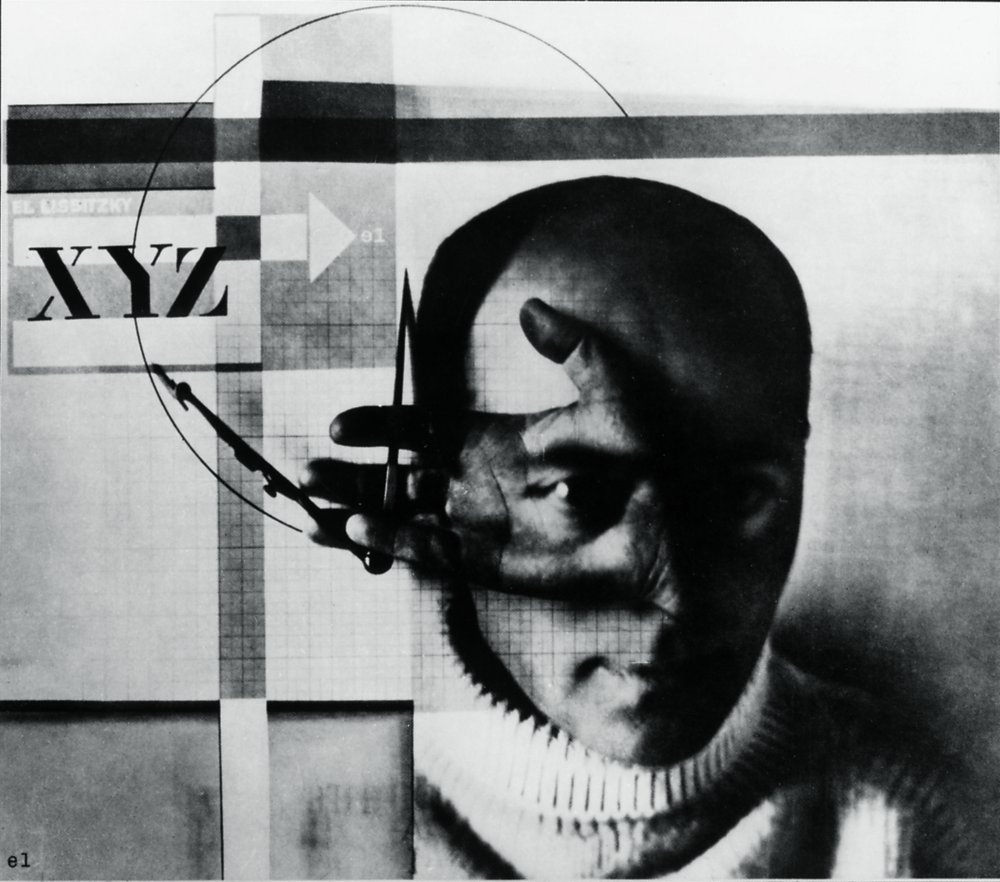
The assemblage of diverse
floating imagery, a reminder of the 1924 silver print self portrait by
El Lissitzky titled The Constructor
seems to sanction Clark’s collage technique although she assembles photographed
images and paints the collage, an opposition
and denial of imagery used allowing an ambiguity of meaning. Fragments
drift and hover on a sinister square. Between blots of white and blue, a
child’s face is carelessly scribbled out, a determined erasure of identity.
Images from other paintings, the fondly painted car and chair, party hat and
cake are in upheaval, deranged. Clark’s painted construction is a portrait of a
constructor, one who is mindful of signifiers, one who is in the midst of
questioning.

Deliberate accident art, ‘Blots’ by Christopher Turner - 1 January
2011 in the Tate Etc. Issue 21 Spring
2011 gives an overview of examples where artists’ deliberate
accidents provided an opportunity to think about range of instigators, like
Leonardo da Vinci who encouraged stains to ‘search for inspiration’, ‘search
for meaning in chaos’. The 18th century painter, Alexander Cozens ‘spilled
sublime’ blot paintings became the subject of his book, A New Method of
Assisting the Invention of Drawing Original Compositions of
Landscape (1785).
J.M.W. Turner, John Ruskin, J.M. Whistler were all
accused of using blots. This technique was eventually picked up by the Dada,
Surrealists, and on throughout this century.
Clark utilized the blot in one of her works, where she has painted
a girl in the top left corner, or that is all that is left of the painting
after the blot is applied. The blot is not the inspiration here, but the
statement. The blotting out, the weight of the spoil is dominant. Christopher
Turner quoted Hans Arp: ‘Chance art, as expressive of modernity, is therefore
uniquely and necessarily modern’.
Clark’s blot may be chance, or it may be intention, or both or neither.
This is not important. Modernity is not important. The blot on the work, has a comforting effect
and affect. It entices like the attraction of what one must not do, and has
done, veering towards another’s humiliation – the attraction of an accident.
Clark’s blot is big in relation to the size of the work. It encompasses almost
the whole picture plane. The deliberation of the deliberate accident can have
so many readings – a quick cover up, a misfortune, or a spill of gleeful
darkness, just for fun? Clark allows the wake of interpreting to be bestowed on
the viewer with a wash of glossy reflection.
'... eyes being seen or not, invoking an image
prevalent in the media of masking the eyes to protect the identity
of either an assailant or a victim (...) implies a level of intimacy – but if
one is to cover the eyes there is a tension between this intimacy and apparent
distance enforced by masking the full identity...'
~ Angela Woodhouse, email interview with Janet McKenzie, 3 March
2010 regarding the MAVEN Commission: Jenny Holzer Collaboration (ARTIST ROOMS,
National Galleries of Scotland and Tate Gallery - Woking Dance Festival &
The Lightbox Gallery and Museum) [11]
Clark paints a group of children around a birthday party table
with black masking strips discomforting to the viewer, the protection from
knowing, intimacy, for all the kids but one. One will be forefront, a boy, the
boy will be identified. He connects us, involves us in the question, the
reaction. A dare. Clark paints a goad, a taunt. Do you have the courage to be
bold, to reveal what is unknown, to most, that you, you are present? The
writing on the wall fades through time passing, the scourge of waiting for the
delayed reaction.
Thomas Mann’s 1912 novella, Der Tod in Venedig was the basis of
the Italian director, Luchino Visconti’s 1971 movie titled Death in Venice
starring Dirk Bogart. He developed a scene in a hotel about 20 or so minutes
into the film an overview of guests gather, where a child with adults would
likely indicate a birthday celebration. Slowly, only hats populate the view,
people become their hats, creating hat silhouettes.
Clark’s golden party goer outline parallels Visconti’s device.
Both develop a contour, melding boundaries between people. The absence of
delineation abridges the event as a glowing festivity, eradicates the precision
of an explanation. The party becomes a synopsis of a story through the
simplified headscape. Clark asserts the evenness of a group encounter as the
light of the muted Harvest Gold memory. Clark supplants detail by a 70s yellow
summary of her party-goer hats, heads bearing points towards the conveyance -
truck and its subheadings as the exterior brought forward, take us beyond the
party modality, its necessity, its negotiations. A reflective, skewed panel, oblique,
cuts through, segregates a darkened, vague counter with subdued staple
containers from curtains that gape open, blood red as Dirk Bogards’ ultimate
lips perched on a sandy shore. The truck’s rear is our focus, what we cannot
see in that beckoning blue metal chassis rifles our vision, robs us of all our
party sense. We are cut out from knowing this secret.

Visconti was noted for utilizing architectural apertures to frame
scenes. [12]
Clark frames a jumble of the remnants of humanity within architectural framing.
Clark’s still life of the pile of clothes is a stilled life where a cake allows
‘truth will out’, truth of feeling will always be discovered – all guises are
left behind. Cake is what is most important, at the forefront, the symbol of all
that is good and enduring in its pink fluffiness, its largess. Stippled as
sweet frosting whipped to peaks, demanding as the lighting and blowing of
candles in one go, to achieve the unspoken wish. However, there are no candles
on this cake. This is the cake of an un-birthday, those days between birthdays,
the ordinary days where the encrusting of swaddled photographs take place and
the mass of the past becomes a swell, hooks to hold all the memories a drawing
to be barely discernible. Clark cloaks the smother of memory, past and future
expectations, giving us a party, besides. All wishes are but one – let’s retain
the birthday party feeling, perpetually and with the joyfulness of childhood,
or at least, the rumpled bundled memories of childhood joy.
********************************************************
[1] First line of the popular birthday song adapted from ‘Good Morning to All’, originally published in Song Stories for the Kindergarten (Chicago: Clayton E. Summy Co., 1896), as cited by Snyder, Agnes. Dauntless
Women in Childhood Education, 1856–1931. 1972. Washington, D.C.:
Association for Childhood Education International. p. 244.