Urban Settings
Dales Gallery
8 April – 4 May 2010
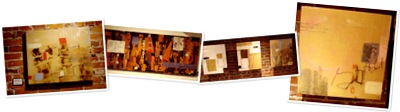
Ira Hoffecker structures perception. She describes the correspondence between architectural reference and historical elements with expansive plotting, Commuting angular shapes to ideas, Hoffecker incorporates the filtration of deep reflection into her canvases. She bolsters her visions with complex stimulation, considering artists like Nicolas de Stael, Robert Motherwell, Hans Hofmann and Robert Rauschenberg. Her unique discernment references that abstractionist vocabulary, while instilling a fresh spaciousness into her work.
Imprints of metal forms encourage an industrial orientation within the canvas plane that builds the agenda for the work. Features, such as text swatches and print transfers delineate the topography of her paintings like fleeting, cherished memories. Drips punctuate with calculated incursion. The visual acuity of some work is cultivated by raising canvas levels, incorporating metal remnants on or under the surface and scraping or sanding paint away to reveal pigment levels, sharing a significant depth of past proceedings.
Hoffecker’s canvases are sometimes raw and stained with squared apertures, hues inviting introspection. They comfortably interrelate cooperatively, with gestural line drawings that dance amongst the calculated balance. Some surfaces are impressed with resin, high gloss lustre that holds the saturated colour strokes, reflecting back to the viewer. She mirrors recollections that exude tenacity. Here, the integrated compositions of abstracted form and materials of cosmopolitan life are a presence that shines fearlessly.
Through Urban Settings, we witness Hoffecker’s visualization of urban life that compels us to relinquish literal identification of city existence for a sincere, intangible understanding of the metropolitan experience. Incorporating snippets and traces of artifices of the world we inhabit, enigmatic layered allusions to history superimpose drenched colour to ascertain a provocative discourse about urbanity. Hoffecker acknowledges the experience can be stark as the unbleached linen she employs or as mesmerizing as the resin glow. She gives us a privileged insight into her lucid analysis. Ira Hoffecker takes us on an unfolding journey.

Friday, April 30, 2010




Thursday, April 29, 2010
Visceral Bodies at the Vancouver Art Gallery by John Luna
The Vancouver Art Gallery
Part of the Cultural Olympiad, the exhibition Visceral Bodies at the Vancouver Art Gallery (curated by Chief Curator/ VAG Associate Director Daina Augaitis) is presented in dialogue with the accompanying show of Leonardo da Vinci’s anatomical studies, The Mechanics of Man. Visceral Bodies is itself divided into three sections, “Visceral Bodies”, “The Scientific Body” and “The Fragmented Body”, invoking both hard and social sciences, or as Gallery director Kathleen Bartels put it, “the body as a subject of anatomical, social and psychological study.” Strange bedfellows with skytrain station advertisements displaying the sleekly x-rayed physiques of athletes in motion (faster without their skin on), the notion of the paired exhibitions is to present Leonardo’s sketches -taboo-transgressing scientific humanism - alongside a more radical inquiry in which ‘humanism’ as such may not survive the procedure by which the taboo is excised.
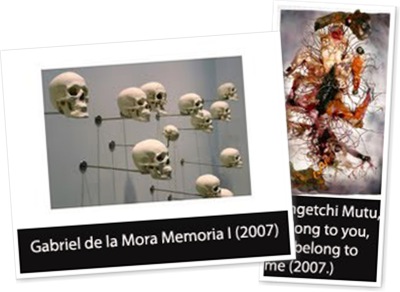
At the entrance to the gallery containing “The Fragmented Body” is a collage by Kenyan-born, New-York based artist Wangetchi Mutu, I belong to you, you belong to me (2007.) Gracefully negotiating attraction and repulsion, smooth skin cut from advertising and illustration presents a soulfully luxurious tension that is ruptured by clutches of plastic pearls that spall incomprehensibly, uncomprehendingly out of unexpected orifices. Skin as such (and our gaze skimming it, drawing pleasure) becomes inadequate to cover what lies beneath (an interior decomposition, or more threateningly, like an expanding universe or spawn of maggots, recomposition.)
Mutu’s materials are at one with her content: Mylar (the synthetic cousin of vellum, calfskin) feels like skin and is manufactured for drafting; craft store ‘pearls’ are at once both agitating grains and corrosive kitsch. Everything frightening in its natural manifestation has its synthetic echo and all of it cajoles, upsets, and ultimately objectifies our involvement. It seems too obvious to say that Mutu’s imagery speaks to gender or race (in another gallery, we see more collages made from old medical illustrations of sexual organs infected with disease), or rather of one race or gender’s view of another exclusively. They are the fear of multiplicitous categories, of mutation, loss of resolution’s dignity and segregating language. They are powerful because they acknowledge that desire undoes these things as readily as disgust or dread.
Other works in this gallery are not as strong. Shelagh Keeley’s Writing on the Body (1988), is a massive multi-panel wall piece consisting of drawing as deliberately crude atavistic/confessional sign systems referencing bodily fluid, internal organs and amputated /alienated body parts. It was originally a site specific piece, in which the artist covered the walls of a gallery in Tokyo with a mixture of wax, Vaseline, and pigment. Here the panels have been cut out of their original architectural environment and propped against the wall, matter-of-fact slabs mostly absent of tension. The space the bodies would seek to assemble themselves in cannot thicken around them or attenuate threateningly…it has become a matter-of-fact slab.
This point is underscored by a small row of drawings on vellum by Betty Goodwin on the opposite wall. The Goodwins are taut by comparison; merciless in their ability to marshal stray swipes of carbon into a deft, dramatic economy. Positioning these two bodies of work across the gallery from one another robs each of something important. Keeley’s work looks like poorly informed illustration when it means after all to appeal directly rather than portray; the terse mythopoeia of Goodwin’s drawings get crowded out by a much larger work that seems to extrovert and vulgarize its palette and technique. It’s a superficial comparison.
Overall, it has to be said, that the gallery would benefit greatly from some judicious editing. The overwhelmingly sensuous affect of works as varied as a papier-mâché skin by Kiki Smith and a video of several sonorous larynxes by VALIE EXPORT would have more impact in an evacuated, clinical environment, the lucid surveillance of a contemporary art space merging with the sterile caution of the care facility.
Perhaps the only work that makes a virtue of the crowding is a haunting sound piece by Teresa Margolles called Sonido de la Morgue/Sounds of the Morgue (2003). A pair of heavily insulated headphones hanging from the ceiling in a corner proffers listeners the sound of an autopsy being conducted on an anonymous murder victim in Guadalajara, Mexico.
The sounds are mostly a continuous, slushy slicing and sawing remarkable for both its professional efficiency and its homogeneity. I am reminded immediately of the seemingly endless string of unsolved murders in Sonora County, excoriatingly documented in Roberto Bolaño’s novel 2666, and like that narrative, the relentlessness of the situation is by turns both horrifying and giddily absurd.
In a crowded space the sound becomes gravely intimate, the grim reaper sharpening his scythe heard as cricket legs rasping together on the fringe of your hearing. It almost feels consoling to note its persistence as one strives to shut out other sounds, feeling the relief that the worst is after all over and the procedure carries on unhurried. It’s only when one tries to have an interior monologue in response, that the continuity of the sound becomes gratingly intrusive. Death is also becoming distracted.
The next section, “The Scientific Body”, suffers from overcrowding, but in a way that more directly undermines the operation of some of the artworks. Notably, works by Gabriel de la Mora and Mona Hatoum propose the artist as manipulator of medical imaging, and rely on a place for the viewer’s body to relate directly to this imagery so as to be implicated in its projected diagnostics.
Mona Hatoum's Deep Throat (1996) presents a blandly innocent dining table and chairs, with a screen neatly inserted on the bottom of a dinner plate. The screen shows a video of an endoscopic exploration of the artist’s digestive tract. The title of this work calls up the famed pornographic film of the same name, with its overlapping associations of eating, speech, and sexual penetration. The arrangement also suggests an homage to the work of surrealist René Magritte, notably Portrait, 1935 (a slice of ham on a plate that stares out at the viewer from an unblinking eye) and The Rape, 1934 (a face whose naïve features are a woman’s nude torso.) The implication is of sexuality without intimacy, but more properly of a body alienated from itself. Like the victim of an eating disorder or childhood abuse, the self of Deep Throat has lost the horizon upon which to envision the negotiation of its thresholds. Paradoxically (and pathologically), nothing can be controlled but everything shall be witnessed.
The problem with the presentation of Deep Throat here is that the room is too crowded to approach the table at some remove, as ordinary domestic tableaux. As a result, the initial sting of bourgeois betrayal is lost. Likewise, the chair is barred from sitting with both conspicuous plastic strapping and a large sign. This seems like museum security overkill, and disrupts the fantasy that it is the viewer’s body that is invited to sit and stare, and by extension, weakens the implication that the abyss we gaze into represents our own internal workings as much as the artist’s.
Likewise, Mexican artist Gabriel de la Mora’s Memoria I (2007) wants to make a space for the viewer as participant. Using MRI technology and a 3D printer, the artist produced seventeen replica skulls based on those of his close family from both live and posthumous scans. These include the skulls of a stillborn sister and deceased father, all placed at their owner’s respective height with the exception of the tiny infant, who appears as if cradled at chest level. As a memento mori or vanitas (reminder of death’s inevitability), the piece is compellingly direct, yet also delicately tactful. At a distance, the synthetic skulls emerge only gradually from the background wall, calling forth their idiosyncrasies and differences as they do so. Up close their appeal becomes more immediate and irresistible, their evident fabrication hinting at both material and virtual presences; the now and the elsewhere, and the later all at once. In a tight space, this transformation is not enabled, and the pieces can too readily be taken up as anthropological curiosity (more Mexican Day of the Dead fun), their mirroring potential passed over.
In the end, it is not really only a question of curtailing or choreographing certain works to a greater or lesser degree. The more important issue is how the various works come together, and it is here the charge of crowding becomes most detrimental. Having two works each by Wim Delvoye and Marc Quinn, for example, means that each piece by a given artist, though distinct formally and conceptually, has more obvious similarities with its sibling than with other pieces in the exhibition, so that the artist’s brand is more strongly enforced than thematic links from work to work across disparate disciplines and milieu. Of two sculptures made by Berlinde de Bruyckere, one maintains a delicate balance of sacred and profane grotesquerie while another is less subtle, weaker in placement and ultimately distracting.
In some cases, artists should have been reconsidered, relocated or not included at all. David Altmejd’s work feels generally ill-placed and out of context. Antony Gormley’s Drift II (2009) accomplishes itself brilliantly in a room of its own while Luanne Martineau’s provocative Dangler (2008), stuffed into a corner by a doorway, is hard put live up to its name. Martineau’s work is strong but much subtler in reality than in reproduction. To deny the work its softer operations is, significantly, to curtail the viewer’s body as well.
Visceral Bodies suffers from organizational problems that obscure both the power of individual artworks and the greater gesture of curatorial intent. I hope it does not sound like post-Olympic grousing to state that the challenge faced by the proposition of Visceral Bodies are a problem of curating as commuting meaning versus programming as engendering spectacle. The body is a potent frame of reference when come upon unexpectedly, offering both the informational shock of the facts of life and the contemplative unpeeling of their artefactual presence. To repeat this revelatory act of skinning the cat so many ways in such close quarters however, is to risk robbing mimesis and allusion of their power to transform in any lasting way, which is to say, within the body of the viewer’s sensibility. Denied sensibility, the works must become bodies without politics.

Wednesday, April 28, 2010
 info: Judi 250-472-2429 or Esther 250-658-4523
Folks,Serota,D.Vinne at Mercurio Gallery

Just in: a fresh crop of landscape paintings from Ken Faulks!
Plein Air season is back on the Peninsula, and Ken has been hard at work creating new oils in his inimitable style. The gallery is hung with a beautiful selection of Faulks paintings in a variety of sizes, moods, and subjects.
And, of course, our sumptuous House Collection remains on offer...
Mercurio Gallery
602 Courtney Street
Victoria BC CA V8W 1B6
Tuesday, April 27, 2010
Off Topic: The 2010 Camosun College Visual Arts graduation exhibit
 This exhibition showcases the talents of artists coming from across Canada, as well as the USA, Japan, Korea and Thailand. For the last two years they have shared studios, tools, and worked together at Camosun’s Lansdowne campus. OFF TOPIC is their second group show off campus before they break out into the local and international art community.
 The 2010 Grad Class includes: Ashley Ahn, Bonnie Hosokawa, Ciao Law, Clara J. Paradis, Clare Elizabeth Rose, Erika Hatano, Inhae Choi, Jenny "Jay" M. Davies, Kana Okamoto, Kazumi Nishikawa, Kori Gladstone, Kristen Wallace, Kyla B. Mitchell, Leanne Weflen, Leyla Mitchell, Leanne Zanon, Megan Bosence, Megan Oliver, Meredith Fraser, Renae Garon, Roshi Clark, Sacha Van Wagenberg, Terri-Lynn Cahill, Tia Casper, Torrance Beamish, Visarut Teerawatvichaikul, Whitney Nichol, Will Rankine, Emily Stevens.
Exhibition continues until April 30, 11am-5pm. Market Square, unit #17A Victoria, BC Canada
video
Monday, April 26, 2010
God Never Dies and That's Good: Art from Oaxaca by Christine Clark

Dios Nunca Muere is a group show of artists from Oaxaca now on at the Deluge and Open Space galleries. For those of you who are not tourist-travellers, Oaxaca is one of Mexico's 31 states. Oaxacans are a people struggling under brutal government control and extreme poverty.
These kinds of conditions don't tend to deter the tourist trade though. In fact, the popular argument is that a poor, downtrodden, even devastated country actually needs and likes tourists because they keep the economy in motion. In this way, not to put too cynical a point on it, people with money (or credit) to blow can enjoy their much needed time in the sun while also helping some poor chambermaid recover financially after her kids were killed in a tsunami. God knows that money is what makes us all happy.
So, Dios Nunca Muere. This show--it was a stroke of genius to bring this exhibition here to Victoria. It is challenging work, it is overwhelming and it is accusing. At both venues there is just so much to see. The only thing missing at Open Space is heat and the smells of cooking and people and the jungle. At Deluge, too, (the more understated venue) the visual is literally overpowering. A huge black and white mural dominates the room and towers over the visitor and it is only one of several pieces in that gallery.
One of the most complex pieces is the first a visitor sees upon arrival at Open Space. Directly at the top of the stairs is a cartoonish figure which at first looks like a McDonald's character, but who is actually wearing a Nazi insignia on it's hat and has an ass for a face. The kind of ass that shits and farts and could also be fucked. The figure is on it's hands and knees. It is called Little Tyrant (small monument to the rebellion). Spoiled children are sometimes referred to as little tyrants. But then again, Moises Garcia Nava, the artist, lives in a place where protesters were shot and killed by their government in 2006.
Also at Open Space were two very large spider shapes made from materials resembling white wicker patio furniture. Between them is a large black jewel shape, a black diamond. In spite of looking like they should be lounging in the hot sun with glasses of mescal at hand, these spiders are positively menacing. They could come alive at any moment and if they did, they would definitely see you. Oh yes.
But who is the white carnivorous spider made from such innocuous-seeming materials supposed to represent? The tourist? Or the person responsible for providing patio furniture and drinks? Nina Simone used to sing a song called Pirate Jenny. It told the story of a black maid/servant/slave woman who rises up against her oppressors with murderous and victorious rage. Those white spiders seem to tell a similar story.
Much of the work is relentlessly sexual, showing brutal, victimizing and one dimensional images of women as objects for use. The enormous wall length mural, for instance, painted by Dr. Lakra at Deluge is a street art homage to the pornographic woman. The women in this work are uniformly naked with upturned porno-tits. They revel, to a woman, in sexual excess. Most of them are sucking cocks or licking what looks like cum. One of them is flat on her back, wearing only sneakers and masturbating.
This painting is an advertisement, carnival style. It is a come-on, a black and white fantasy that could never be real. With the greater context of this show in mind, one must ask, what is the reality of women as sexual objects in Oaxaca, or anywhere for that matter? What promise is this? And what about those dirty girls on the street at dusk, sick from drugs and drinking.
Back at the Open Space venue, some of Rosa Vallejo's Drawings take us to the grotesque reality of sex as tourist trade. In one of her gird of drawings we see a young theatrical looking girl on her back with one ankle twisted behind her head. All around her, and as an integral part of the very structure of the image is a face, repeated over and over. The face of a bland, blonde, smiling man, someone who looks like Ken-doll. Someone having fun, simple as simple.
Another drawing, also at Open Space, this one by Alfonso Barranco Sanchez, shows another girl, just her face, lying sideways, and looking like a girl too sick to make her own decisions anymore. All around her are fingers and she is being urged to suck them because that is what love is.
Oh, love and money. How vulnerable we all are when it comes to love and money. Some of us are more vulnerable than others. If we've been denied something we need, then sometimes we do anything to have it, even when "it" isn't the real thing. Like sucking fingers/cocks or welcoming tourists. Friendship and economic security.
But what about the people behind all this presumptuous stereotyping? This show, Dios Nunca Meure, is a crowded and bewildering installation of art, music, danger and sex. The curators have presented us with the stereotype of Mexico as a destination. Even the non-tourist knows from the movies and from the news that all of Mexico is a dark dirty carnival with fat white bodies, like leeches, draped everywhere for sun. And yet it is the tourist, in the shape of Deborah de Boer, who has traveled repeatedly to Oaxaca, who has helped to bring this show, one of the best we've seen, to Victoria. Unfortunately, tourism, like a lot of life, is complex and difficult to resolve.
Thank goodness that God Never Dies (Dios Nunca Muere).
At Deluge Contemporary Art and Open Space until May 1, 2010 Video
Sunday, April 25, 2010
Salons de Refuses at Coast Collective Gallery

In the mid-1800’s in Paris, artists were experimenting with exciting new approaches to art, but could not show their work in public unless they were accepted into the established Salons (galleries). Many of the works the Salons rejected at the time are still considered great art today, and might be unknown except that in 1863, Emperor Napoléon III decreed that the rejected artists could exhibit their works in a “Salon des Refusés” adjacent to the regular Salon, "Wishing to let the public judge...”, and whole new schools of art emerged.
We invite you to our Salon des Refusés for a chance to see for yourself works that have not been included in other local shows. Now you can be the judge!
April 29 to May 16
Thursdays through Sundays
Noon to 5:00 PM
Friday, April 23, 2010
Yuri Arajs and Christian Nicolay by Debora Alanna
Point of Reference
View Art Gallery
104-860 View Street
Victoria, BC V8W 3Z8
9 April – 8 May 2010
Whether we are transported to where “every known superstition in the world is gathered into the horseshoe of the Carpathians as if it were the centre of some sort of imaginative whirlpool...”[i] [Faith in Mythology- Nicolay ‘lay down’ and installation], or to the withstanding of whirlwind cycles, luckily miniaturized and accounted for within [Two Hundred and Seventy Tornados - Arajs], we are presented with a “Point of Reference”. At the View Gallery, Yuri Arajs and Christian Nicolay concurrently show individual viewpoints, implicitly referring to a personalized vocabulary of material, comportment and meaning. Deferential to found objects or materials, each artist yields to reclaimed matter, imbedding or challenging inference and allowing a departure of imagination to develop further. “Point of Reference” provides a summit to consider probing exploration and stimulate discovery.
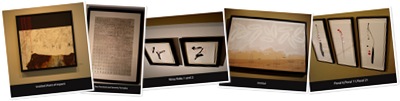
Arajs deftly metamorphoses rusted metal and knotted wood into weathered vistas that direct us to reflect on artful landscaping. Surfaces smartly marked with scores, lithely applied paint, spots of pigment and layers of tempered stratum juxtapose with sheets of abrasion to recalibrate a presupposition that may occur with horizontal demarcation. Attrition through weathering becomes rue, an affecting territory. Encircling within atmospheres, cell-like features intensify horizons with insistent clarity. Cheerful dots speak, sometimes as monologue expositions [Untitled (Silver Moon) and Untitled (Island Landscape)], or vexing duet [Untitled (Point of Impact)], often gathering in chorusing clusters to adorn, enunciate the pictures’ voice as charming triggers [Untitled (red landscape)] and [Floral (#11), (#6), (#21) / Kirsu Koks1 & 2 (Cherry Tree 1 & 2)]. Alluring and mesmerizing, they conjure remote celestial bodies or plot floral accents that toy seriously. [Untitled (Kelowna)] references trenchant flurry, grounding and segregating the horizon of fire with gritty underpinning. Arajs consistently transforms unpretentious material through vociferous amalgamation, creating contemplative expanse.
Nicolay works with diachronic referencing, developing a visual linguistic through found, then engaged objects and imagery. Each work confidently reveals stories that encapsulate stages of idea deliberation and augmentation. He uses a medley of means to record his empirical processing, often building the descriptors over several years. Nicolay bluntly documents validation and justification within relationships, [I like cats, she’s the dog] and [Faith in Love], queries and thwarts trust and reliance [Faith in Money]. He questions the source of edification and acknowledges confused communication with ineffectual chalkboard erasers, their erasing function supplanted with chalk stalks and Chia growth / demise [Tower of Babel]. These works are conniving recounts of Nicolay’s quests, which wily commentate with commitment and spry enthusiasm.
[i] Stoker, Bram. “Dracula.” 1897. Free Public Domain E-Books from the Classic Literature Library
Video
View Art Gallery
104-860 View Street
Victoria, BC V8W 3Z8
9 April – 8 May 2010
Whether we are transported to where “every known superstition in the world is gathered into the horseshoe of the Carpathians as if it were the centre of some sort of imaginative whirlpool...”[i] [Faith in Mythology- Nicolay ‘lay down’ and installation], or to the withstanding of whirlwind cycles, luckily miniaturized and accounted for within [Two Hundred and Seventy Tornados - Arajs], we are presented with a “Point of Reference”. At the View Gallery, Yuri Arajs and Christian Nicolay concurrently show individual viewpoints, implicitly referring to a personalized vocabulary of material, comportment and meaning. Deferential to found objects or materials, each artist yields to reclaimed matter, imbedding or challenging inference and allowing a departure of imagination to develop further. “Point of Reference” provides a summit to consider probing exploration and stimulate discovery.
Arajs deftly metamorphoses rusted metal and knotted wood into weathered vistas that direct us to reflect on artful landscaping. Surfaces smartly marked with scores, lithely applied paint, spots of pigment and layers of tempered stratum juxtapose with sheets of abrasion to recalibrate a presupposition that may occur with horizontal demarcation. Attrition through weathering becomes rue, an affecting territory. Encircling within atmospheres, cell-like features intensify horizons with insistent clarity. Cheerful dots speak, sometimes as monologue expositions [Untitled (Silver Moon) and Untitled (Island Landscape)], or vexing duet [Untitled (Point of Impact)], often gathering in chorusing clusters to adorn, enunciate the pictures’ voice as charming triggers [Untitled (red landscape)] and [Floral (#11), (#6), (#21) / Kirsu Koks1 & 2 (Cherry Tree 1 & 2)]. Alluring and mesmerizing, they conjure remote celestial bodies or plot floral accents that toy seriously. [Untitled (Kelowna)] references trenchant flurry, grounding and segregating the horizon of fire with gritty underpinning. Arajs consistently transforms unpretentious material through vociferous amalgamation, creating contemplative expanse.
Nicolay works with diachronic referencing, developing a visual linguistic through found, then engaged objects and imagery. Each work confidently reveals stories that encapsulate stages of idea deliberation and augmentation. He uses a medley of means to record his empirical processing, often building the descriptors over several years. Nicolay bluntly documents validation and justification within relationships, [I like cats, she’s the dog] and [Faith in Love], queries and thwarts trust and reliance [Faith in Money]. He questions the source of edification and acknowledges confused communication with ineffectual chalkboard erasers, their erasing function supplanted with chalk stalks and Chia growth / demise [Tower of Babel]. These works are conniving recounts of Nicolay’s quests, which wily commentate with commitment and spry enthusiasm.

[i] Stoker, Bram. “Dracula.” 1897. Free Public Domain E-Books from the Classic Literature Library
Video
Thursday, April 22, 2010

Wednesday, April 21, 2010
Wendy Welch for exhibit-v !
We are super happy to announce that Wendy Welch will be our contributor to the new section WRITE-UPS !
Wendy’s practice includes sculpture, painting, and drawing, art writing and curatorial work. Wendy has taught at the Victoria College of Art, the University of Victoria and Camosun College. Wendy has recently had a solo exhibition at Open Space and the Southern Alberta Art Gallery. Wendy is founder and director of the Vancouver Island School of Art.
MFA, University of Victoria
BFA, Concordia University
Wendy’s practice includes sculpture, painting, and drawing, art writing and curatorial work. Wendy has taught at the Victoria College of Art, the University of Victoria and Camosun College. Wendy has recently had a solo exhibition at Open Space and the Southern Alberta Art Gallery. Wendy is founder and director of the Vancouver Island School of Art.
MFA, University of Victoria
BFA, Concordia University
Miriam Mulhall & Jan Johnson at Collective Works Gallery

Collective Works Gallery presents:
Musings on the ALM sculpture gardens-
one hectare at the edge of Sooke
Photography and Sculpture
Opening Reception: Fri. April 23, 2010
7-9 pm
Video
Tuesday, April 20, 2010
Roshi Clark at Open Space

Open Space presents new work by emerging artists Roshi Clark's Things To Do addresses the mental abundance of to-do lists in contemporary culture. His installation uses a plethora of sticky notes to make significant connections between people's intended actions, routines and relationships to public space.
Opening: Thursday April 22, 7:30 p.m. Picnic, below Open Space. 508 Fort St.
Continues to May 5. Video


Friday, April 16, 2010
Jan Johnson by Debora Alanna
Jan Johnson’s sculpture is climatic. Eight of Johnson’s works contribute to the Urban Settings show at the Dales Gallery. His distinctive welded steel and ‘found objects’ , discarded metal remnants, merge and culminate in constructions that surpass the authenticity of the raw and cast-off matter found in urban locals. Although Johnson’s materials refer to the urban build, he dwells on the exacting experiences that are a consequence of urbanity. Shrewdly, Johnson’s pieces disclose perspicacity. Each an individual world, the works reveal meanings of extensive ideas that result from experiencing an urban life. These sculptures bristle, maximizing the methodical bonding of metal, realizing tantalizing allegory.
With God of Unforeseen Consequences, Johnson may allude to a god like Chacmool, Tenochtitlan – Aztec; however, his work shunts this resemblance with the tree extension from the god’s groin. This work celebrates the outbreak of capacity possible when we acknowledge the mysterious corollary of inspiration.
Garden of Delights involves Hieronymus Bosch’s influence. Johnson’s version minutely renders the delight of cavorting around two exposed, twisting pinnacles and the angst of the never-ending party. The dry vessel that holds this extravaganza remarks on the enchantment of revelry. Too much delight parches our sensibilities. What can purify and cultivate growth of positive spirit, in excess, can desiccate and diminish beauty.
Time Saving Truth From Falsehood is a sculptural parable. The story balances on a corroded disc indicative of a faceless clock, where Time shoulders Truth, impaling Falsehood. Time’s piercing spear forms a style on the plate, where integrity prevailing over perversion perpetually triumphs.
Framing the Birth of Adam in a deteriorated flat screen TV, we become privy to the entrapment of a legendary numinous event. Bedraggled hangings enmesh lounging Adam and the pointing finger that brought him to life. Johnson makes us voyeurs to this dilapidated launch. This version of Adam’s birth is a commentary on our need to see an event on TV to believe its veracity, and the decay of belief in a mystical spectacle.
Market Goddess rules over the minions scrambling up a mechanism of archaic commerce, the oxidized innards of a metal cash register. Sycophants cluster in the backside, as well. Johnson’s edifice shows how ruthless business belittles those that worship money.
Johnson is at ease constructing universal concepts, capturing the core of metaphor, symbol and more. Sinews of metallic components, elaborately wrought, produce sumptuous contributions to our understanding of disproportionate regulation (Policy Machine), susceptibility to opportunism (Arc) and the isolating disclosure of influence (Trinity). Johnson’s sculptures are encapsulated chronicles intricately told.
© Debora Alanna
Urban Settings: Jan Johnson sculpture with abstract paintings by Ira Hoffecker
Dales Gallery -537 Fisgard St, Victoria BC
8 April – 4 May 2010 Video

With God of Unforeseen Consequences, Johnson may allude to a god like Chacmool, Tenochtitlan – Aztec; however, his work shunts this resemblance with the tree extension from the god’s groin. This work celebrates the outbreak of capacity possible when we acknowledge the mysterious corollary of inspiration.
Garden of Delights involves Hieronymus Bosch’s influence. Johnson’s version minutely renders the delight of cavorting around two exposed, twisting pinnacles and the angst of the never-ending party. The dry vessel that holds this extravaganza remarks on the enchantment of revelry. Too much delight parches our sensibilities. What can purify and cultivate growth of positive spirit, in excess, can desiccate and diminish beauty.
Time Saving Truth From Falsehood is a sculptural parable. The story balances on a corroded disc indicative of a faceless clock, where Time shoulders Truth, impaling Falsehood. Time’s piercing spear forms a style on the plate, where integrity prevailing over perversion perpetually triumphs.
Framing the Birth of Adam in a deteriorated flat screen TV, we become privy to the entrapment of a legendary numinous event. Bedraggled hangings enmesh lounging Adam and the pointing finger that brought him to life. Johnson makes us voyeurs to this dilapidated launch. This version of Adam’s birth is a commentary on our need to see an event on TV to believe its veracity, and the decay of belief in a mystical spectacle.
Market Goddess rules over the minions scrambling up a mechanism of archaic commerce, the oxidized innards of a metal cash register. Sycophants cluster in the backside, as well. Johnson’s edifice shows how ruthless business belittles those that worship money.
Johnson is at ease constructing universal concepts, capturing the core of metaphor, symbol and more. Sinews of metallic components, elaborately wrought, produce sumptuous contributions to our understanding of disproportionate regulation (Policy Machine), susceptibility to opportunism (Arc) and the isolating disclosure of influence (Trinity). Johnson’s sculptures are encapsulated chronicles intricately told.
© Debora Alanna
Urban Settings: Jan Johnson sculpture with abstract paintings by Ira Hoffecker
Dales Gallery -537 Fisgard St, Victoria BC
8 April – 4 May 2010 Video

Cameron Martin,Cait Helten & Cara Makkinga at "Chimera" -Xchanges Gallery

Chimera
Victoria College of Art —
2010 Graduation Exhibition
Cameron Martin - Coastal Small Towns. “By depicting small towns in my set of works I hope to show their warmth and full character. Their surroundings curiously seem muted to them, but not us. Holding true to my roots, I try to show experiences, left with me while travelling our vast land”.
Cait Helten - “My work is focused on portraits using tone, texture and light to create an individual atmosphere for each subject”.
Cara Makkinga - “All of my works are created though mixed media techniques. Instead of being linked through common subject matter my mixed media paintings are linked with colour scheme, techniques and they all express a word starting with the letter M. They are in the world of abstract, based on simple images that are meant to bring a bigger concept to the mind of the viewer”.
Opening Reception : Fri. April 16, 2010 7 to 10pm Video
Thursday, April 15, 2010
Augustus Magus for exhibit-v!
We are pleased to announce that Augustus Magus will be other of our contributors to the new section WRITE-UPS !
Augustus Magus
* BFA (Visual Arts, Honours), University of Victoria, Victoria, BC.
* Film and Video, Emily Carr University of Art + Design, Vancouver, BC.
Augustus Magus
* BFA (Visual Arts, Honours), University of Victoria, Victoria, BC.
* Film and Video, Emily Carr University of Art + Design, Vancouver, BC.
Jeff Molloy at Winchester Galleries in Oak Bay.

Jeff Molloy's mixed media renderings of Hudson's Bay blankets are smaller than life-size but larger than life in meaning. They hold the shape and colour of a blanket, but their two dimensional outline imply far more than a warm covering. These blankets are the woolly essence of Canada. They hint of wood smoke and weary trappers, of exploration and exploitation, canoes and commerce, the history of a people and the making of a nation.
They are fabric icons of Canada, part of A Canadian Portrait, an exhibition comprised of mixed media works by Jeff Molloy. They will join his hockey sweaters, Canadian country churches, moose and Prime Ministers sporting everything from lumber jackets to buckskins. With titles such as “Lost in the Woods” and “The Original Six” A Canadian Portrait is a textural exploration of the meaning of Canada, a rendition of warp and woof that has brought the artist first to question and then to embrace his country.
Molloy will also debut his “Canadian Story Boxes”, an ongoing series of interactive mixed media assemblage depicting Canadian stories such as Louis Riel, John McRae (Flanders Fields), The Rocket (Maurice Richard), Billy Bishop and of course the Blanket.
"The Group of Seven made paintings of where we live, not who we are. I want to create work that tells the story of the people, the history, the iconic imagery and the legends that are the fabric of this country" Molloy says. “For the past 15 years I have been working to create art that conjures up the spirit of Canada”.
Molloy has been referred to as a farmer of art. He creates multi-dimensional, multi-sensory works that bring emotion to the people who experience them, and energy to the spaces they inhabit.
Jeff’s art does not depend on subject or materials alone, it is created through a wide variety of distinctive techniques, tools, and personal processes; resulting in truly unique, instantly recognizable Jeff Molloy originals.
Exhibit runs until May 1, 2010 Video
"Manufacturing Suburbia" at Boucherat Gallery

Local artists Darren Larose, Jennifer Toke and Liam Hanna-Lloyd will be displaying a selection of their newest paintings, drawings and collages.
April 9 to 25, 2010
Opening Reception, Thursday, April 15th, at 7:30pm.
Video
Detlef Grundmann and Ian Laval at Coast Collective Gallery

The exhibition is the work of two Vancouver Island designer/furnituremakers, Detlef Grundmann and Ian Laval. The first works with more contemporary designs and the second is closer to the classic tradition. Both are dedicated professionals.
DetlefGrundmann produces one-of-a-kind furniture pieces and a range of smaller, functional items, including unique boxes. Ian Laval, a full-time professional furnituremaker since 1970, makes pieces in a more traditional vein, with cautious forays into a more contemporary mode. They share a common interest in using native materials –among them Vancouver Island’s Garry oak and big-leaf maple, Douglas fir, maple and a variety of others.
Both are concerned with the integrity of traditional construction. Clean lines, curves and natural shapes are a signature of Grundmann’s style. Proportion embellished by stunningly beautiful veneers sawn from local trees is Laval’s stock-in-trade.
Both furnituremakers are escapees from previous and greatly different careers. Each lives in the Victoria area. The exhibition is supported by selected paintings, woodturning and fabric art by Kathy Cameron, Phil Cottell & Barri Hearn, Zara Lau, Vicki Postl, Lisa Riehl & Tim Soutar.
The show is open Thursday to Sunday each week from April 15-25, noon to 5:00pm.
Wednesday, April 14, 2010
Ron Parker at The Avenue Gallery

Inspired by a Fenwick Lansdowne exhibit, Ron took his first step at age 35 and began doing vignetted paintings of wildlife and was soon recognized as one of North America's premier wildlife artists. Drawing on the discipline developed as the Canadian Decathlon champion, Ron applied himself full time to improving his art. In the years following, he explored a number of styles - figurative, portraiture, impressionism and sculpture.
Journey back 30 years to the origins of Ron Parker's painting style and walk his evolutionary path to his refined landscapes of today. Experience the privilege of seeing over 70 paintings in all styles as well as bronzes.
Exhibit runs until April 24, 2010


Claude Tousignant at Winchester Gallery on Broad St.

Claude Tousignant was born in 1932 in Montreal and has lived and worked there for most of his life. His practice, internationally recognized for its unique and significant contribution to the history of art, is essentially about colour interaction and monochrome. The many important exhibitions devoted to Tousignant's work include a mid-career retrospective that opened in 1973 at the National Gallery of Canada (before travelling to twelve other major centres) and the very large and widely acclaimed retrospective held last year at the Musee d'art contemporain de Montreal.
Exhibit runs until May 29, 2010
152 West Hastings Artist Studio at Fifty Fifty Arts Collective

152 West Hastings is an artist studio in the DTES, a neighborhood experiencing gentrification. The studio, located across from the new Woodward's development, is one of the last buildings on the block that has not been renovated. In an uncertain environment its young artists seek to carve out their space and persist in creating innovative artwork. They are friends of varying backgrounds and represent different schools of practice.
Exhibit runs until April 30, 2010
Fifty Fifty website
Tuesday, April 13, 2010
Luke Garrison and the Art of Photomontage
(The) Artist speaks Series by Augustus Magus
as part of the collective exhibit “ On the Journey…Art of Hope and Recovery” March 19-April 15, 2010 Caffe Fantastico (corner of Kings and Quadra, Victoria, BC)
This piece is called “Metropolitan”(2010). It is a homage to the late 1800’s-early 1900’s way of colouring photos. It also involves Architectural drawing images. The end result attempts to portrait a human being who is coming from the countryside or a small town to the big city. She looks in astonishment at these structures. Her face is eclipsed by the shadows of these buildings. She is waiting for the fullness of time.

This other piece is called “Nouveau”(2006). The woman is jazzy. She comes from an ad in the 30’s. The tone is lyrical and bright. There is an emulation of decorative symbols and of the codes used in manufacturing. I scratched the target design only. The vertical structure is an image of a house done by Paul Klee and modified by me in Photoshop. The piece tries to make reference to the simpler times. Artists, in my opinion, want to escape to simplicity.

This piece is called “Par avion” (2009). The woman is a suffering Saint in an emblematic sort of beauty. ‘Contents’ and ‘Saints’ are both subjected to rigorous inspection by authorities, either Government or Church. She looks up to her Saviour. When I work in certain pieces like this one, Grace comes to inspire me into Beauty.

“Madonna & Child” (2005). For this piece I used a photograph that I took near Perugia, Italy. The background comes from a card that I bought somewhere else in Europe, perhaps France. I liked the tactility of the flesh of the Virgin coming through, like a fingerprint on her face or as computer circuitry boards.

I studied at the Ontario College of Art & Design and graduated in 2005 in Advertising. I really didn’t want to go into Advertising. I studied at the College because of the access to the computers. I had issues with the integrity of Advertising. I did not want to partake of a lucrative lifestyle that I did not like. That is, to retrain myself visually and then reframe the Truth to make others consume.
In my opinion, the earliest advertising that exists is when the serpent pushed the apple to Eve.
I just want to make Art and Beauty.
Luke Garrison.
Duncan Regehr at Winchester Gallery on Humboldt St.

The tale of a life begins before it is born…
CYPHER explores the theory that for each being there exists a distinct image, an invisible matrix…the essence of that being…holding the key to its life’s calling. ~Duncan Regehr
Duncan Regehr’s CYPHER works are based on the philosophy that we each possess a design code, a blueprint of ourselves, defining character, physical presence and individual destiny. His richly resolved oil paintings reveal imaginary subjects as they manifest into final template images. Figures emerge from darkness as if arriving from quantum depths, galvanized and bathed in golden light. Jewel-like colours and abstract shapes morph into schematic patterns and human features. Solid pigments work beside delicate grid-work to contrast translucent shading and fluidity, giving a sense of both permanence and transience. These thought-provoking works executed in Regehr’s distinctive style of expressive surrealism, offer fresh credence to the theory that everything has a form from which it is derived.
Exhibit runs from April 6 to 24, 2010
Victoria, BC Canada
Irma Argyriou, Kumiko Fujinami and Jillian Player at Slide Room Gallery


" A Sequence of Spaces "
The Slide Room Gallery is pleased to host the first graduates of the Vancouver Island School of Art's new Independent Studio Program.
Participants: IRMA ARGYRIOU, KUMIKO FUJINAMI and JILLIAN PLAYER.
The Independent Studio Program is a post-diploma or 'fourth year' program where students work in a shared studio space under the advisement of a Independent Studio Program supervisor. Most of the work in the exhibition has been completed in the last six months of the program.
Exhibit runs from April 9 to April 26, 2010
.jpg)
Thursday, April 8, 2010
Grant Watson –Sculptfiction- by Debora Alanna
Grant Watson’s show, Sculptfiction displays a broad oeuvre of 17 sculptures. The range of his deft vigour is evident in Calle Muro and his ability to demonstrate edifying, confident humour is unmistakable in Before I Lay Me Down To Sleep. His work narrates, describing insight through sculptural investigations. Watson’s inventive material use and most importantly, a considerate deliberation of various human experiences delivers jostling perspectives through witty visual banter, seductive colouration, calculated texture and wistful sculptural practice.
Lectern is a podium for raising our understanding of intense, primal activity. Like a yoni-lignum, Watson embodies the sexuality of human interaction through the structural integrity of emblematic forms. A multifaceted, undulating and corrugated shape clutches an extruded sphere on one side of a waveform. An unyielding phallic fringe, secured by a carved petal relief pokes out at the edges of the void hemispheric cavity on the other half of this interpretive duality. This taunt encourages visceral contact, enticingly and pawing simultaneously. The edging constructs a protective picket. Inside the opposite embracing waveform, similar picketing surrounds the extruded sphere within the encirclement. Watson expounds the opposing contrasts of yes and no, of open and closed, where our perpetual symbiotic dichotomy is in constant flux.
Watson’s Private Idaho measures forfeiture. He describes precarious development, which induces displacement of domesticity. Perched on top of a yellowed ovoid is a vacant white house icon. Watson dares to acknowledge the valued presence of sloppy oozing, ideas that collect brightly and separately, in spite of attentive maintenance to balance - the forfeit. This undefined green substance is the genesis of new opportunity cradled in the unique measuring mechanism that supports the tilting elliptical symbol of contrived optimism.
How Owed Are You cunningly refers to the tiny music box that turns the tune ‘Happy Birthday’ found in the centre of this brash wall work. Redness shouts robustly; however, tool marks, subtle below the red-stained surface gently caress the studded plane, placating the need to remember antecedents to this presentation of assertiveness.
Figurative works include the wall sculpture, I Dream in Red. A boy’s vulnerability is perched on a pyramid of steps. The red arched background shrouds his dream state, which truncates his mind from his body. Ballooning ideas hover above. Here, Watson’s whimsy balances the significance of this narrative. The dreamer cannot see the strength that supports him, the walled structure below, concealed by delineated steps. A wall of bricks under the dreamer is firm yet sometimes protrudes. This construction reveals potency and strength that supports innocence, which is impressionable. Watson’s construct of the future shows narrates how we are dependent on the consequence of the dream. All dreams. Grant Watson’s work is the result of disciplined dreaming.
Grant Watson Website
video

Lectern is a podium for raising our understanding of intense, primal activity. Like a yoni-lignum, Watson embodies the sexuality of human interaction through the structural integrity of emblematic forms. A multifaceted, undulating and corrugated shape clutches an extruded sphere on one side of a waveform. An unyielding phallic fringe, secured by a carved petal relief pokes out at the edges of the void hemispheric cavity on the other half of this interpretive duality. This taunt encourages visceral contact, enticingly and pawing simultaneously. The edging constructs a protective picket. Inside the opposite embracing waveform, similar picketing surrounds the extruded sphere within the encirclement. Watson expounds the opposing contrasts of yes and no, of open and closed, where our perpetual symbiotic dichotomy is in constant flux.
Watson’s Private Idaho measures forfeiture. He describes precarious development, which induces displacement of domesticity. Perched on top of a yellowed ovoid is a vacant white house icon. Watson dares to acknowledge the valued presence of sloppy oozing, ideas that collect brightly and separately, in spite of attentive maintenance to balance - the forfeit. This undefined green substance is the genesis of new opportunity cradled in the unique measuring mechanism that supports the tilting elliptical symbol of contrived optimism.
How Owed Are You cunningly refers to the tiny music box that turns the tune ‘Happy Birthday’ found in the centre of this brash wall work. Redness shouts robustly; however, tool marks, subtle below the red-stained surface gently caress the studded plane, placating the need to remember antecedents to this presentation of assertiveness.
Figurative works include the wall sculpture, I Dream in Red. A boy’s vulnerability is perched on a pyramid of steps. The red arched background shrouds his dream state, which truncates his mind from his body. Ballooning ideas hover above. Here, Watson’s whimsy balances the significance of this narrative. The dreamer cannot see the strength that supports him, the walled structure below, concealed by delineated steps. A wall of bricks under the dreamer is firm yet sometimes protrudes. This construction reveals potency and strength that supports innocence, which is impressionable. Watson’s construct of the future shows narrates how we are dependent on the consequence of the dream. All dreams. Grant Watson’s work is the result of disciplined dreaming.
Grant Watson Website
video
Wednesday, April 7, 2010
Ira Hoffecker and Jan Johnson at Dales Gallery


URBAN SETTINGS
Abstract paintings
Ira Hoffecker
Sculpture
Jan Johnson
Opening Reception April 8, 2010 7-9pm
Tuesday, April 6, 2010
Debora Alanna for exhibit-v!
We are pleased to announce that Debora Alanna will be other of our contributors to the new section WRITE-UPS !
I write about sensibilities projected by work considered. I discuss the essence, what is contingent to the art, what is projected. Art succeeds to transform our understanding. My writing features these observable facts.
In the 90’s the Hong Kong publisher, Ian Brown of Asian Sculpture News, now World Sculpture News included my articles on sculptural practice - individuals and group expositions in his publication. The Times of India, Ahmedabad published my features on culture, relationships connecting architecture and urbanity, and the culmination of curators’ visions in group exhibits. For the last decade, my professional writing, utilized by non-profit organizations, has facilitated consideration of pertinent public issues.
A graduate of Ontario College of Art, my art practice has enabled expositions in Brazil, Kazakhstan, Spain, France, Italy, India and Canada. My new home, Victoria, is creating vitalizing developments in my career. Writing for Exhibit-v is a welcome opportunity to share my observations about art in this on-line context. In my writing, I will discuss art to further the artist’s audience. I consider myself an advocate for artists. Your views about my explications are welcome.
Blog
I write about sensibilities projected by work considered. I discuss the essence, what is contingent to the art, what is projected. Art succeeds to transform our understanding. My writing features these observable facts.
In the 90’s the Hong Kong publisher, Ian Brown of Asian Sculpture News, now World Sculpture News included my articles on sculptural practice - individuals and group expositions in his publication. The Times of India, Ahmedabad published my features on culture, relationships connecting architecture and urbanity, and the culmination of curators’ visions in group exhibits. For the last decade, my professional writing, utilized by non-profit organizations, has facilitated consideration of pertinent public issues.
A graduate of Ontario College of Art, my art practice has enabled expositions in Brazil, Kazakhstan, Spain, France, Italy, India and Canada. My new home, Victoria, is creating vitalizing developments in my career. Writing for Exhibit-v is a welcome opportunity to share my observations about art in this on-line context. In my writing, I will discuss art to further the artist’s audience. I consider myself an advocate for artists. Your views about my explications are welcome.
Blog
Christian Nicolay and Yuri Arajs at View Art Gallery

The gallery is pleased to present an exhibition by two BC artists, Christian Nicolay and Yuri Arajs, April 9th to May 8th. The opening reception is Friday, April 9th, 6-9 pm and we sincerely hope you will be able to attend. Both artists will be present at the opening.
Christian Nicolay's interdisciplinary art practice combines performance, mixed media drawing, sound recording, installation and video; often simultaneously playing with notions of chance, spontaneity and humour, exploring the relationships between order and chaos, and the unity of opposites. He summarizes his art and life by "paying attention to systematic confusion".
Yuri Arajs' landscapes are painted on carefully selected wood panel where the grain and warmth of the wood are integral parts of the painting. Painted elements are precise and he only paints what is absolutely necessary to the work. A horizon might be a perfect subtle graphite or painted line. Other paintings are on pieces of found metal where all precision is abandoned in the riot of rust and distressed elements.
Anthony Thorn at Eclectic Gallery

“Golden Treasures and Other Works” by Anthony Thorn
Exhibition Date: April 6th through May 1st
Artist Reception: Sunday April 11, 2-4 pm
Anthony Thorn follows a great lineage of master gilders, painters and carvers in creating
his “wall jewels”. Following techniques established a thousand years ago, and revived
during the Renaissance, Thorn’s craft has been used to adorn icons, sacred and mystic
images. Though a self proclaimed secular artist, his own Jewish faith appears a source
of inspiration in many of his works.
More than six decades of artistic creativity have produced over 1100 paintings hanging
in private and corporate collections including the Art Gallery of Greater Victoria. He is an
artist of significant accomplishment, and one who in the maturity of his career is, in his
words, “compelled to make beautiful things and put them into the world”.
Eclectic Gallery
Sunday, April 4, 2010
John Luna for exhibit-v !
We are pleased to announce that John Luna will be contributing to our new section - WRITE-UPS
John Luna is an artist who works primarily in painting and installation, as well as a writer and instructor. He has exhibited installations of paintings in connection to poetry, video, sculpture and historical artifacts, in Victoria, Kelowna, Calgary, Portland, San Diego and San Francisco. John has published catalogue essays and criticism in Victoria, Vancouver, Calgary, Winnipeg, Toronto, Los Angeles and Jakarta. He has taught at the Vancouver Island School of Art, the University of Victoria, the University of Lethbridge, the University of Calgary, the Metchosin International Summer School of the Arts, The Art Gallery of Greater Victoria, The Victoria College of Art and Camosun College. He is also involved in coordinating exhibitions as Chair of the Slide Room Gallery.
http://johnluna.ca/
John Luna is an artist who works primarily in painting and installation, as well as a writer and instructor. He has exhibited installations of paintings in connection to poetry, video, sculpture and historical artifacts, in Victoria, Kelowna, Calgary, Portland, San Diego and San Francisco. John has published catalogue essays and criticism in Victoria, Vancouver, Calgary, Winnipeg, Toronto, Los Angeles and Jakarta. He has taught at the Vancouver Island School of Art, the University of Victoria, the University of Lethbridge, the University of Calgary, the Metchosin International Summer School of the Arts, The Art Gallery of Greater Victoria, The Victoria College of Art and Camosun College. He is also involved in coordinating exhibitions as Chair of the Slide Room Gallery.
http://johnluna.ca/
Friday, April 2, 2010
Cam Reid in "Question Period "


1- What is more important to you? The subject matter or the composition or structure?
It all depends on the work, my idea, and what I want to accomplish formally. Much of my work is based in technical ability as a painter, with the composition and structure at the forefront, the subject matter just becomes a recognizable form for me to hang marks and brushstrokes on. A lot of my other works however, are purely about subject matter. I can only speak for myself, but I think work naturally becomes more about subject matter, as it becomes more conceptual (as oppose to formal). This is of course a generalization, but my sculptural works are a good example. They are plater and wax representations of books and journals, with screenprints and transfers on them. The composition and placement of the prints and transfers are fairly unimportant, and one could argue the need for sculptural realism is as well. The only things that matter are that they are recognizable as books, they can't be opened, and are heavy as hell.
2-Is the title important for you?
Title is important to me if it informs the work. If the title can give a bit of an "ah ha!" moment, or at least a push in that direction I will include it. Otherwise I give my works superficial titles based on the names of my subjects (when they have specific subjects) just so I can call them something when I talk about them, or else I will just leave them untitled.
3-Should art be created to withstand the test of time or is it more realistic to create works that eventually wears away?
This is another "that depends" answer. Many works like paintings, monumental sculpture and other, more traditional media are most often created with the intention of being archival, unless the medium doesn't allow it, or it's part of the artist's intention for the work to deteriorate in one way or another. A lot of other work however is meant to either be time based, deteriorate, or lose it's physical presence in one way or another. Performance art is a good example, as it only exists to people in documentation form (with obvious exception to those present at the performance). Photos and videos are not the work, and will never be able to represent it in a way that gives it justice. This certainly doesn't cheapen the work in any way, it's just not physically present through history. The same could also be said for other experiential works, Net.art, and many other media.
4-Do artists create art to have their ideas validated or so that they can be accepted?
I don’t really think these are the only two answers. I can only speak for myself, but I feel like many artists create work in order to acknowledge ideas in a creative way, thus illuminating them to their viewers. It is amazing how potent elements of our culture can become when simply repackaged and presented in a clever, original way with an artist saying “hey look at this part of our culture”. This is at least why I do what I do, which answers you final question I suppose.(5-Why do you do what you do ?)
bluecanvas.com/cam_reid
Thursday, April 1, 2010
John Bodnar at Dales Gallery

AUDACIOUS FLING
Opening Reception 7 to 9 pm
April 2 , 2010
Dales Gallery
537 Fisgard St.
"Dios Nunca Muere" a group exhibition at Deluge Contemporary Art and Open Space Galleries

April 2 to May 1, 2010
Dios Nunca Muere
the visual politics of transmutation in contemporary Oaxacan art
José Arnaud Bello | Alfonso Barranco Sánchez
Ana Belén Paizanni | Arian Dylan | Moisés García Nava
Joel Gómez | Mariana Gullco | Daniel Guzmán
Luis Hampshire | Saúl Hernández | Dr. Lakra
Morelos León Celis | Roberto López Flores
Saúl López Velarde | Rolando Martínez
Rosa Vallejo | Jessica Wozny
Deluge Contemporary Art, 636 Yates Street, Victoria
Open Space, 510 Fort Street, Victoria
Opening: Friday, April 2: 7 to 10pm at Deluge, 9pm to 12am at Open Space
Artists/Curators Talk: Saturday, April 3, 3pm at Open Space
Subscribe to:
Posts (Atom)