
Showing posts with label Robert Youds. Show all posts
Showing posts with label Robert Youds. Show all posts
Thursday, September 28, 2017


Thursday, September 14, 2017
Robert Youds at Winchester Galleries on Fort Street

Robert Youds : City Cut Flowers
September 14 to 30, 2017
Opening Reception: Sept. 14, 2017 - 7pm
Winchester Galleries
665 Fort St.
Tuesday, October 29, 2013

Wednesday, May 29, 2013

Sunday, April 29, 2012
Laura Gildner Art Review
Review: Robert Youds- Room Upgrade for a Pacific Northwest Afternoon at Deluge Contemporary Art
Laura Gildner, Critical Studies II
Exploring the ideas of time and space, Robert Youds' Room Upgrade For A Pacific Northwest Afternoon at Deluge is an experiment in perception. Departing from the traditional utilitarian functions of fluorescent light, Youds' use of the medium is prominent throughout the installations. At once powerful, reflective, and mesmerizing, Room Upgrade for a Pacific Northwest Afternoon creates a space where time becomes non-linear and perception must submit itself to the meditative and sometimes disorienting qualities of the atmosphere the show creates. By richly enhancing our sense of sight through the interactions of artificial and natural light in a controlled space, Youds challenges the way we perceive ourselves and our relationships to the self.
Upon entering the gallery, the viewer is most instinctively gravitated towards Room upgrade for Pacific Northwest afternoon, the show's title piece, a series of florescent light bulbs both resting against and framing a set of square wood panels. The panels, each varying slightly in size and forming a collective square backdrop, are reminiscent of a rustic and weathered structure. More organic in their raw, unfinished state, they form a stark contrast and platform upon which to display the prominent fluorescent bulbs of varying heights and sizes. These light sources are displayed in fragmented positions spaced at various distances from each other, instantly enveloping the viewer in their collective power. The pull of the light immediately forms a detachment from the world left outside the gallery, and time almost seems stand still as the viewer takes in its commanding yet tranquil glow. It is only after removing oneself from the light's hold that the awareness of its ability to momentarily suspend the self in what seems like an air pocket of time occurs.
Continuing counterclockwise through the gallery, the viewer is brought to wood is resilient in earthquakes. Formed with layers of grey and yellow plexiglass, wood is resilient in earthquakes sits low to the floor, it's brilliant yet graceful light source resting behind the layers of glass. Much smaller in scale than Room upgrade for Pacific Northwest afternoon, wood is resilient in earthquakes' light is nevertheless at once strong, glossy, and serene, glowing dynamically like a sunset over the water. The echoes and soft hums of its light source aid in creating a meditative stage upon which to reflect as thoughts are lost to the light. As soothing as it is sublime, wood is resilient in earthquakes gives the viewer a resting point between the intensity of Room upgrade and the awakening buzz of usonian cave.
Suspended from the ceiling much like a traditional lamp, usonian cave's function is anything but. The only kinetic piece in the exhibit, usonian cave is a collection of heavy, industrial chains printed on a layer of transparency rounded into a quasi lampshade. Adding a necessary tension to the otherwise static pieces of Room upgrade, usonian cave flashes rotating squares of neon light from beneath it's covering. Quietly mimicking the pace of life that exists outside the confines of the gallery walls, usonian cave is nevertheless unyielding in it's ability to remind the viewer of the power that can come from stillness. As hypnotizing as it is active, usonian cave toys with the viewer's sense of awareness and state of presence as they are led towards turn on your electric.
Perhaps the most pacifying of the installations in the gallery, turn on your electric sits eerily still before the cathedral-like windows of the gallery space. Interacting with the architecture in an almost ideological way, it exists as a moment frozen in time. Made up of two large panels consisting of an array of bright, multicolored plexiglass squares, turn on your electric orchestrates a projection of colour through the gallery as it connects with the natural light pouring in from behind. Two neon lights and a surfboard, presented preciously between the panels like an artifact from a museum of the mind, compete for the viewer's attention. These elements still fall short to the virtue of tremendous colour and luminoscity created by the natural light, however do serve as a tomb to the passing of time. Provoking a state of contemplation and introspection, turn on your electric seems to naturally free the viewer from its grasp once a state of reflection has been achieved. It is only then that an awareness of the self comes to the surface, and the viewer is brought back to the present.
Serving as a bridge back to the realities and rhythms of the real world whizzing by below the gallery, Erickson's cabin is the last piece of the exhibition. While possibly the least invasive to the senses, Erickson's cabin is also the most resonant. Muted and faded light glows steadily like an old memory under a thick box of frosted glass. Beneath it's shell, the viewer can almost sense the thought of a time experienced, unsure of of its importance. Feelings of nostalgia begin to develop before becoming interrupted by the recognition of a single cedar square placed atop of the object itself. The shingle, mirroring the wooden panels of Room upgrade, give the viewer a sense of resolution, of somehow coming around full circle to the exhibit’s experience in altered perception.
It is only after departing the gallery that the viewer can experience the full effects this show has on the psyche. Disorienting and surprising in it's immediate contrast, the repercussions in returning to the accelerated state of being outside this controlled space the leave the viewer feeling almost whiplashed back into reality. What truly resonates after experiencing Room upgrade, however, is the delicate moment in time that Youds' creates. His ability to produce an environment that transfixes the viewer into a state of surrender is truly powerful, and this beautiful escape from our perceived reality is well worth the visit.
Thursday, March 29, 2012
Room upgrade for Pacific Northwest afternoon by ROBERT YOUDS review by Debora Alanna
Deluge Contemporary Art
636 Yates Street
Victoria, BC, Canada
9 March - 15 April 2012

Room upgrade for Pacific Northwest afternoon is an allegorical poem, a collection of works that stand individually yet interact as illuminated poems hearkening, aware of mortality, or, stanzas of an epic that encompasses abstract ideas - resonant timelessness. Interacting with composed light, colour and shape, texture and form, Youd’s ideology dispels a disposition of power and liberation, a vigilant temperament made palpable through urban vernacular. His material relationships respond spatially and texturally within each work and amongst the works exhibited, echoing the considerable evidence of affecting time with light as the means to expand his discourse, poetically.
Ericson’s cabin


Housed in an opaque light box, Erickson’s cabin beams with Youds timed sunshiny light apparatus among mysteriously illuminated hidden shapes. Involving a patch of thin, layered cedar slats mounted on the top right corner, Youds tells a cabin story, a story of isolation where thought processing is demonstrated. Confined in a box, ambiguity of imperfect form is toughened by the unyielding sheath containing the instrumentation. Contrasting the rough and emotional reality of wood symbol with expressive shadow interplay within the three-dimensional window, a portal to intimacy possible in the confines of an ordinary cabin-life and distilled living is achieved.
In Arthur Erickson’s address to McGill School of Architecture students, 21st of October 2000, Erickson talked about how “Out of the most ordinary circumstances a transcendental experience is distilled. Though lacking in cerebral challenge, since it is beyond the limits of the brain it gives its viewers a sense of highest fulfillment. “Robert Youds said, at a recent Q & A for Megan Dickies’s University of Victoria class held at the Deluge visiting Youds exhibition, “Room upgrade for a Pacific Northwest afternoon, “I distill down what’s on my mind.” Youds allows us to glean the mottled, consistently changing unevenness within a mystery, attached to the stiff, refined wooden sheaths, the surround of cabin dwelling, combined, is the means to exist beyond the material world, which is at the heart of this tone poem.
turn on your electric


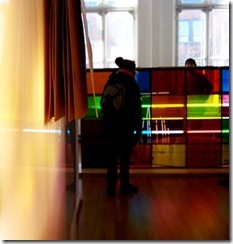
Identified with cabin life in the Pacific North West, turn on your electric holds a surfboard in the clarity of triangulated colour patches, mapping what cannot be obtained or used. A dream beholden to prospective scenarios. Echoing the patch of wood on Erickson’s cabin, the placeholder for contemplation, these lucid patches blush and influence electrifying possibilities embodied by the loafing board. This work has inspiration placed sideways, Carpe diem, seizing contrition, barred from a dream, the allusion to hope is nearly a glossy, tinted Incandescence, crossed by bands of florescence and Youds insists a command will enable change.
Youds provided a bench for viewers to look through the tented work on its window side, so the whole gallery of pieces become coloured by pinks, red and turquoise squaring commanding fantastic, recreational simultaneousness, and turn electric with engaging multiplicity.
usonian Cave


This work requires some preface.
In 1903, in his book, “Here and There in Two Hemispheres” [1], James Law coined the word Usonian, a means of describing something exclusively American, as in of the United States of America. The term was later employed by the architect Frank Lloyd Wright, who designed Usonian dwellings, homes that were post-war practical and economical for the baby boomer families. Wright, in his Selected Writings 1894–1940 considered the writings of Samuel Butler, an author that also employed the Usonia concept, to explain his architecture for straightforward, utilitarian, yet homey homes. Arthur Erikson, a familiar Pacific Northwest (Canadian) architect escaped to travel, but did not escape Wright’s “absolutely beautiful blending of building and landscape." [2] influence which he developed in his own commanding, spiritually receptive with sensitivity to light and the surrounds he built within.
The Greek philosopher, Plato as part of his work, The Republic, included The Allegory of the Cave to demonstrate “our nature in its education and want of education” (514a), is a fictional dialogue between Plato’s teacher Socrates and Plato’s brother Glaucon at the beginning of Book VII. The Allegory of the Cave is preceded by the metaphor of the sun (507b-509c) and the analogy of the divided line (509d-513e).
In the cave, a group of people chained to a central partition inside the cavern, immobile all of their lives, face a blank wall where shadows project on the wall by things passing along a walkway in front of a fire behind them. In the story, Socrates elucidates that the shadows are the prisoner’s view of reality. He explains how the philosopher is like a liberated prisoner, who comes to understand that the shadows he looked at when forced to face forward only are not essential to the particular nature of the objects or entities that made shadows. The Allegory relates to Plato’s Theory of Forms, where “Forms” or “Ideas” and not the changeable material world known to us through sensation, and possess the epitome of reality. Accordingly, only knowledge of the “Forms” establishes true knowledge.
An aria, a solo song of intricacy, with usonian cave, Youds suspends the Usonian ideology and combines Plato’s allegorical cave where chains of connotation dangles. Youds hangs reality. With printed chains on acetate, blackening shadows flicker in square neon variation, chinks freed on the fixture. The Usonian, or everyman’s cave, a home for the free, is a place where ideal truth can be found, if released from the fetters that diminish spiritual veracity. The flash of square forms reiterates ideas that are timelessly tested. Is the Usonian concept caving into the shadows of perfection? Is a philosophy that enlightens ruined by structure? Youds materializes sensation with ideals.
wood is resilient in earthquakes


A peek into the naked framing of the work, wood is resilient in earthquakes, Youds exposes the yellow light of fear, the heart of how the absence of concrete applications affects this tragic poem - believing in security does not make it so. A landscape of grey tones with horizontally awry tubing disturbs the embedded parallel fixture. The oblong wood feels protective as it houses the blocks of glassy gradation. Resilient, the wooden hold has trusting structure, but here, faith is an imperfect scheme. Resilience has value; however, the quaking earth can test horizontal toughness, and be found wanting. Youds reveals the view into understood vulnerability. If Tturn on your electric is a plea for living, wood is resilient in earthquakes, although an optimistic thought, is a description of the failure to be resilient. Youds grounds this opposing elegy for those who may pass, a presage of fatality in our Pacific Northwest if we do not act to protect ourselves from earth quaking certainty. Or in Prosperos’s words, “release me from your bands..now I want Spirits to enforce, art to enchant...Let your indulgence set me free” (Epilogue 1-20, The Tempest, William Shakespeare)
Room upgrade for Pacific Northwest afternoon


The namesake of Youds exhibition, Room upgrade for Pacific Northwest afternoon is a lyrical ode to life in situ, an upgrade to familiar existence within the Pacific Northwest, while evolving the room, otherwise known as our psyche or internal space, fortitude or spirit, which may relate to our physical place for consideration, and Gaston Bachelard, author of Poetics of Space, would say, and as the roofing implies an attic space, upgrading our clarity of mind.
In a person’s life, the afternoon can relate to our 50’s, where one is still active and thriving, where one can change and benefit from new shafts of light or ideas or formulations, and one is equally capable of expanding the disseminating knowledge, contributing to the world we participate in, improving it with upgraded presentment. Youds work articulates and advances Platonic metaphysics, dividing the line, multiplying it, making it vertical, active and interactive. Visibility and intelligibility are synonymous in his work. Youds makes his florescent, luminescent lines dance on a cedar rooftop, indigenous to the Pacific Northwest, framed by the square of a window that we have seen in more incisive detail in Erickson’s cabin, another kind of cave. In this work, the hold, the repose is beneath the tilting slats, protecting the mindful interiors where the form of synchronistic ideas, connected with electric possibility are simultaneously exposed and supported by the framework of straightforward, humble roofing architecture. Circular holes, discreet round apertures in the roof allow the breadth of something more, where the void is a possibility, and sublimates the sunny shines within Erickson’s cabin. Robert Youds reveals fortitude in the material of illumination through inherent, enduring inspiration, distilling the light of his poetry on us.
[1] James D. Law, Here and There in Two Hemispheres (Lancaster: Home Publishing Co., 1903), pp. 111–12n.
[2] Martin, Sandra. "The greatest architect we have ever produced," The Globe and Mail, Friday, May 22, 2009.
636 Yates Street
Victoria, BC, Canada
9 March - 15 April 2012

Room upgrade for Pacific Northwest afternoon is an allegorical poem, a collection of works that stand individually yet interact as illuminated poems hearkening, aware of mortality, or, stanzas of an epic that encompasses abstract ideas - resonant timelessness. Interacting with composed light, colour and shape, texture and form, Youd’s ideology dispels a disposition of power and liberation, a vigilant temperament made palpable through urban vernacular. His material relationships respond spatially and texturally within each work and amongst the works exhibited, echoing the considerable evidence of affecting time with light as the means to expand his discourse, poetically.
Ericson’s cabin


Housed in an opaque light box, Erickson’s cabin beams with Youds timed sunshiny light apparatus among mysteriously illuminated hidden shapes. Involving a patch of thin, layered cedar slats mounted on the top right corner, Youds tells a cabin story, a story of isolation where thought processing is demonstrated. Confined in a box, ambiguity of imperfect form is toughened by the unyielding sheath containing the instrumentation. Contrasting the rough and emotional reality of wood symbol with expressive shadow interplay within the three-dimensional window, a portal to intimacy possible in the confines of an ordinary cabin-life and distilled living is achieved.
In Arthur Erickson’s address to McGill School of Architecture students, 21st of October 2000, Erickson talked about how “Out of the most ordinary circumstances a transcendental experience is distilled. Though lacking in cerebral challenge, since it is beyond the limits of the brain it gives its viewers a sense of highest fulfillment. “Robert Youds said, at a recent Q & A for Megan Dickies’s University of Victoria class held at the Deluge visiting Youds exhibition, “Room upgrade for a Pacific Northwest afternoon, “I distill down what’s on my mind.” Youds allows us to glean the mottled, consistently changing unevenness within a mystery, attached to the stiff, refined wooden sheaths, the surround of cabin dwelling, combined, is the means to exist beyond the material world, which is at the heart of this tone poem.
turn on your electric


Identified with cabin life in the Pacific North West, turn on your electric holds a surfboard in the clarity of triangulated colour patches, mapping what cannot be obtained or used. A dream beholden to prospective scenarios. Echoing the patch of wood on Erickson’s cabin, the placeholder for contemplation, these lucid patches blush and influence electrifying possibilities embodied by the loafing board. This work has inspiration placed sideways, Carpe diem, seizing contrition, barred from a dream, the allusion to hope is nearly a glossy, tinted Incandescence, crossed by bands of florescence and Youds insists a command will enable change.
Youds provided a bench for viewers to look through the tented work on its window side, so the whole gallery of pieces become coloured by pinks, red and turquoise squaring commanding fantastic, recreational simultaneousness, and turn electric with engaging multiplicity.
usonian Cave


This work requires some preface.
In 1903, in his book, “Here and There in Two Hemispheres” [1], James Law coined the word Usonian, a means of describing something exclusively American, as in of the United States of America. The term was later employed by the architect Frank Lloyd Wright, who designed Usonian dwellings, homes that were post-war practical and economical for the baby boomer families. Wright, in his Selected Writings 1894–1940 considered the writings of Samuel Butler, an author that also employed the Usonia concept, to explain his architecture for straightforward, utilitarian, yet homey homes. Arthur Erikson, a familiar Pacific Northwest (Canadian) architect escaped to travel, but did not escape Wright’s “absolutely beautiful blending of building and landscape." [2] influence which he developed in his own commanding, spiritually receptive with sensitivity to light and the surrounds he built within.
The Greek philosopher, Plato as part of his work, The Republic, included The Allegory of the Cave to demonstrate “our nature in its education and want of education” (514a), is a fictional dialogue between Plato’s teacher Socrates and Plato’s brother Glaucon at the beginning of Book VII. The Allegory of the Cave is preceded by the metaphor of the sun (507b-509c) and the analogy of the divided line (509d-513e).
In the cave, a group of people chained to a central partition inside the cavern, immobile all of their lives, face a blank wall where shadows project on the wall by things passing along a walkway in front of a fire behind them. In the story, Socrates elucidates that the shadows are the prisoner’s view of reality. He explains how the philosopher is like a liberated prisoner, who comes to understand that the shadows he looked at when forced to face forward only are not essential to the particular nature of the objects or entities that made shadows. The Allegory relates to Plato’s Theory of Forms, where “Forms” or “Ideas” and not the changeable material world known to us through sensation, and possess the epitome of reality. Accordingly, only knowledge of the “Forms” establishes true knowledge.
An aria, a solo song of intricacy, with usonian cave, Youds suspends the Usonian ideology and combines Plato’s allegorical cave where chains of connotation dangles. Youds hangs reality. With printed chains on acetate, blackening shadows flicker in square neon variation, chinks freed on the fixture. The Usonian, or everyman’s cave, a home for the free, is a place where ideal truth can be found, if released from the fetters that diminish spiritual veracity. The flash of square forms reiterates ideas that are timelessly tested. Is the Usonian concept caving into the shadows of perfection? Is a philosophy that enlightens ruined by structure? Youds materializes sensation with ideals.
wood is resilient in earthquakes


A peek into the naked framing of the work, wood is resilient in earthquakes, Youds exposes the yellow light of fear, the heart of how the absence of concrete applications affects this tragic poem - believing in security does not make it so. A landscape of grey tones with horizontally awry tubing disturbs the embedded parallel fixture. The oblong wood feels protective as it houses the blocks of glassy gradation. Resilient, the wooden hold has trusting structure, but here, faith is an imperfect scheme. Resilience has value; however, the quaking earth can test horizontal toughness, and be found wanting. Youds reveals the view into understood vulnerability. If Tturn on your electric is a plea for living, wood is resilient in earthquakes, although an optimistic thought, is a description of the failure to be resilient. Youds grounds this opposing elegy for those who may pass, a presage of fatality in our Pacific Northwest if we do not act to protect ourselves from earth quaking certainty. Or in Prosperos’s words, “release me from your bands..now I want Spirits to enforce, art to enchant...Let your indulgence set me free” (Epilogue 1-20, The Tempest, William Shakespeare)
Room upgrade for Pacific Northwest afternoon


The namesake of Youds exhibition, Room upgrade for Pacific Northwest afternoon is a lyrical ode to life in situ, an upgrade to familiar existence within the Pacific Northwest, while evolving the room, otherwise known as our psyche or internal space, fortitude or spirit, which may relate to our physical place for consideration, and Gaston Bachelard, author of Poetics of Space, would say, and as the roofing implies an attic space, upgrading our clarity of mind.
In a person’s life, the afternoon can relate to our 50’s, where one is still active and thriving, where one can change and benefit from new shafts of light or ideas or formulations, and one is equally capable of expanding the disseminating knowledge, contributing to the world we participate in, improving it with upgraded presentment. Youds work articulates and advances Platonic metaphysics, dividing the line, multiplying it, making it vertical, active and interactive. Visibility and intelligibility are synonymous in his work. Youds makes his florescent, luminescent lines dance on a cedar rooftop, indigenous to the Pacific Northwest, framed by the square of a window that we have seen in more incisive detail in Erickson’s cabin, another kind of cave. In this work, the hold, the repose is beneath the tilting slats, protecting the mindful interiors where the form of synchronistic ideas, connected with electric possibility are simultaneously exposed and supported by the framework of straightforward, humble roofing architecture. Circular holes, discreet round apertures in the roof allow the breadth of something more, where the void is a possibility, and sublimates the sunny shines within Erickson’s cabin. Robert Youds reveals fortitude in the material of illumination through inherent, enduring inspiration, distilling the light of his poetry on us.
[1] James D. Law, Here and There in Two Hemispheres (Lancaster: Home Publishing Co., 1903), pp. 111–12n.
[2] Martin, Sandra. "The greatest architect we have ever produced," The Globe and Mail, Friday, May 22, 2009.
Monday, March 5, 2012

Thursday, October 6, 2011

Subscribe to:
Posts (Atom)