
Showing posts with label The fifty fifty arts collective. Show all posts
Showing posts with label The fifty fifty arts collective. Show all posts
Friday, January 19, 2018


Thursday, October 12, 2017

Monday, October 2, 2017
Tuesday, January 31, 2017
Kasper Boss-Moodie at The Fifty Fifty Arts Collective

Kasper Boss-Moodie is a current visual arts student at the University of Victoria. He has exhibited in British Columbia and Ontario. Kasper works with sculpture and installation to explore themes of vulnerability, the body, and tangibility.
Sunday, December 4, 2016
Thursday, December 1, 2016

Wednesday, August 10, 2016
Tuesday, May 31, 2016
Tuesday, March 15, 2016
Wednesday, March 2, 2016
Friday, January 15, 2016
Wednesday, November 4, 2015
Saturday, August 22, 2015
Jaedan Chayce Leimert Q&A about the show “Hollow” at the Fifty Fifty Arts Collective with Sheila R. Alonzo

1. What can you tell me about Hollow?
Hollow as a concept, is quite different than my previous work. There is a very sincere
directness in the pieces. I felt an impetus to create a new body of work that reverted back
to more natural materials, rather than synthetic ones. The show also meditates on ideas of
emptiness, transience and memory.
2. How did you decide on the specific materials?
I’m often influenced by my immediate surroundings. At the time of Hollow’s conception,
I was living in the Shuswap, staying at my family’s cabin out in the woods. In a way, the
show is a product of my time there. Being enveloped in a forested environment definitely
had an effect on me, insofar as a sense of rawness coinciding with quietness. This is more
or less the feeling I was trying to convey in using untreated pieces of wood. I’m also
drawn to the idea of material decay. Wood has a wonderful duration of wear – the change
is imperceptible in the present, yet somehow it’s materially embodied.

3. Where did you source the materials?
Some of pieces came directly from the Shuswap (the charred stump & hollowed logs),
while others were fabricated in Kelowna and Vancouver. It also helps when your father is
a carpenter.
4. What about 'the presence of absence' is meaningful to you?
For me, it’s a way of appreciating both positive and negative space equally. Many of the
pieces have empty space between, or within the objects themselves. The emptiness is
contained. I think that each medium achieves this feeling in different ways. The
sculptures are obviously very physical, while the photographs for example, contemplate
more abstractly on the space that exists in memory, or perhaps more accurately, forgotten
memory.
For me, it’s a way of appreciating both positive and negative space equally. Many of the
pieces have empty space between, or within the objects themselves. The emptiness is
contained. I think that each medium achieves this feeling in different ways. The
sculptures are obviously very physical, while the photographs for example, contemplate
more abstractly on the space that exists in memory, or perhaps more accurately, forgotten
memory.

5. When did you decide that arrangement is of equal importance to the individual pieces?
Part of what’s interesting as a viewer is to make correlations between work; finding threads of connection, whether it’s the artist’s intention or not. It was important for me to arrange the
objects in a way to best facilitate an overarching dialogue. I like to think of it in regards to
Koffka’s phrase “the whole is other than the sum of its parts.”
In terms of when, Hollow as a unified show was decided long before any of the actual
pieces were created.
6. Are there any pieces that are part of the exhibit that did not make it in the exhibition?
For certain. I find that the final decision is always contingent on the chosen exhibition
space. There were other ideas for potential sculptures or for another set of photographs,
but when I actually sat down and envisioned how I was going to arrange the works there
wasn’t really a good place for them. I decided that it was better to X them rather than to
plug them in just for the sake of it.

7. What's next?
I have a couple new ideas that I would like to work out simultaneously. One of which
will be a spatial installation, in collaboration with an engineer friend of mine, Sam
Melamed (who helped me with Fringe I-VI). It will involve laser light and resonating a
milled slab of wood. The other is to start fabricating new works for an exhibition I have
in mind entitled, disorder. The show will be based on subversion. My vision is for it to be
uncomfortable, disjointed and perhaps slightly grotesque.

Monday, August 10, 2015
Emily de la Cruz Ellis at the Fifty Fifty Arts Collective

Thu. August 6th 2015 - Fri. August 21st 2015 @ the fifty fifty arts collective
I was born deaf. My mother would recall how I would press my hands against the living room speakers to feel the vibration of music. These electroacoustic objects, constructed to make speech and music audible, created wonder and innumerable emotions in my tiny mind and body despite my profound lack of sound perception. While I regained my hearing at the age of three, I believe the early absence of this sense gave me a hyperawareness of the importance of tangible objects in enhancing one’s reality. The art object as a tangible entity has the ability to shape experience. My work is designed with the purpose of enriching one’s life.
The influence of Canadian Art and the West Coast aesthetic has molded my practice. The spirituality of the wilderness is reflected in the incorporation of indigenous materials in my work. I have also been fortunate to be instructed under First Nations artists. While we don’t share the same faith, their ability to navigate the contemporary art world while drawing on the integrity of their traditions has been a powerful model of how I can
represent my lineage in a physical and tactile manner.
Through my sculptural practice I have realized my passion for materials and the balance of their construction reflects my desire to create meaningful experiences for the viewer. Tangible elements of color, texture, and light have the ability to reflect intangible values. As I delve more in to the creative sphere I recognize the communicative potential of a sculptural object in dispatching my thought, convictions, and ideology.
Art allows me to create tangible environments and objects that can nurture an awareness of sensory understanding in viewers that may have been silenced through past encounters or lack of experiences.
Presented by: the fifty fifty arts collective
Tuesday, July 21, 2015
Monday, July 13, 2015
Jaedan Chayce Laimert at the Fifty Fifty Arts Collective

The exhibition is reductive, reflective and delineates a raw poeticism.
Jaedan Chayce Leimert completed his BFA in Visual Arts from the University of Victoria in 2013, and is now based in Vancouver, British Columbia.
The Fifty Fifty Arts Collective
opening reception: Thurs. July 16, 2015 at 7 pm
Wednesday, June 17, 2015
Interview with Leya Tess about ‘Ólafsfjörður Drawn’ by Sheila R. Alonzo

‘Geysers, volcanoes and portals into the centre of the earth’ were some exciting inspirations Leya Tess drew from when we talked about her current exhibition at the fifty fifty arts collective in Victoria, BC. For six weeks, Tess was tucked away at the Listhús Artist Residency program in a small fishing town connected by a tunnel in northern Iceland. Weathering arctic 1.6°C this spring, Tess watched the landscape turn from no plants to moss plants emerging out of the snow. Observations such as these informed her exploration on multiplicity and interconnection. As a result, she created an intuitive web, playfully drawing the eyes to bulbous shapes and sounds of her residency in the fjord documented in a 24ft scroll. ‘Ólafsfjörður Drawn’ exhibition runs until Sunday June 21st, 2015.

SA: What is it about the arctic island of Iceland that fascinates you?
LT: I think something special happens to places that are surrounded by water, rather than artificial political borders. The physical isolation of an island can cultivate a certain type of introversion that seems to produce fantastic art. Artist centres can also be islands of sorts; safe havens of creativity/ dedication at their best - to self-absorbed old boyz clubs at their worst.
SA: When you arrived, was it what you expected it to be?
LT: Before the trip I had some romanticized ideas about Icelandic society, mostly informed by the following naive (but endearing) reasons: 1) My adoration of Bjork 2) Media hype over the country's constitutional reform 3) The looming danger of being surrounded by 30 active volcanoes. Upon arriving I realized that there were plenty of other twenty-something tourists smitten by identical ideals.
SA: What were your first AND long lasting impressions?
LT: It should've been obvious but throughout the residency I was amazed at how much deeper I could explore my drawing practice. Who would have thought: lonely days devoid of obligation & distraction = productivity!

SA: If you could do it again, what would you do differently?
LT: The next time I do another residency, I hope to be a little less self-absorbed and create work that directly engages with a host community.
SA: Does your dual nationality (Chinese and Swedish) inform a lot of your work?
LT: Yes. The complexity of being mixed race, Yin-yang dualities, perceived binaries of east & west, black & white, absence & presence are things I think about while I draw.
SA: You mentioned a strike during your residency. Did that impact you? LT: I spent two days on hold with Icelandair trying to rebook my return flight.
SA: When you returned to Canada, you drew ‘Siglufjordur,’ Egilstadir’ and ‘Myvatn’; what can you say about these smaller pieces in the exhibition.
LT: Those were really fun and liberating - I used some of the forms I learned on the scroll on a smaller scale.

SA: Is there any piece that is part of the exhibition that is not in the show?
LT: I accidentally left another unfinished, smaller scroll at the residency.
SA: Hugo Nebula was at your Opening Reception, what can you tell me about the band?
LT: Hugo Nebula is named after the Hugo and Nebula awards for science fiction. It’s mostly the spacey synthesized sounds of the talented Reuben Wier but sometimes I add in my experiments in video mixing projection imagery.
SA: Did you have a show while you were there?
LT: Yes. I met a tombstone engraver who also makes impressive paintings.
SA: Any plans for your next exhibition?
LT: I’m working on an outdoor installation for the Campbell Bay Music Fest on June 19-20, 2015 on Mayne Island, BC.
www.leyatess.com
leyaand@gmail.com
Image 1 – Text: This spring, Leya hitchhiked across Iceland with an awkwardly large roll of paper. Eventually she found her way to the Listhús Artist Residency in the small fishing village of Ólafsfjörður. Tucked away in a snowy fjord she bathed in the luxurious privilege of an abundance of time, frozen foods and geothermal heat. Following a methodical routine, she filled the 24ft roll of paper with an intricate web of intuitive freehand drawing.
These monochromatic drawings swim out into the waters of multiplicity and cyclical movement. They are obsessive mark meditations that tap into the intertwined and mutually engaged undercurrents that are most often obscured by the daily drudgery of the standard western grind. -LT
Below Text: a cut-out sample of the palette.
Image 2 - Artist Leya Tess standing in front of the 24ft Ólafsfjörður Scroll
Image 3 - Framed drawings (L to R): Siglufjordur, Egilstadir and Myvatn
the fifty fifty arts collective is a non-profit artist-run centre that provides space for artists of all disciplines who have yet to be defined in the mainstream {intimate music, art and film programming}. Hours: Monday 1-6 / Wednesday 10-6/ Friday 10-330/ Sunday 9-12 Contact: thefiftyfifty@gmail.com
Photos: Sheila R. Alonzo
Iceland Map: Wikipedia
Wednesday, June 10, 2015
Interview with Sergio Rojas Chaves by Sheila R. Alonzo
Sergio Rojas Chaves is an artchitect-to-be studying art at the University of Victoria. When asked where he was born, he laughed. ‘Chepe,’ (Chaves calls San Jose) is the city where no one lives. The Costa Rican capital experiences a daily flux of people: from half a million to 400,000 day and night, he said. The irony of becoming an architect in a city where no one lives builds the case for Chaves in ‘re-thinking the city’ and its relation to the environment. Chaves remembered when mining and deforestation made an impression on him in high school, that in sculpture class, he shaped the stone to speak about these issues. He did not realize at the time that he would work with stone again, suspended at the fifty fifty arts collective in Victoria, BC, to challenge our thinking about materiality, space and environment in May 14-31, 2015. ‘Una Superficie Tangible / A Tangible Surface’ is his first solo exhibition in Canada.
‘Sergio’s exhibition provides a thoughtful inquiry into the meaningfulness of our interactions with the objects of our everyday comings and goings –reminding us of the intimacy that informs even the most banal encounters with the surfaces of the natural world.’ –Megan Dyck, artist & educator

![clip_image002[1]](https://blogger.googleusercontent.com/img/b/R29vZ2xl/AVvXsEjkcWOjTsgfxwpijo8UNh59j4QSsCCgsB0NQRkCMZ6b_N47jGcvXANrnO6oPNQ7T94HStQYk1B8Hw8kAfO1HaCD6Bmx2qsIk7gSbZTn-0xd-gn9FGJVEoEqH0A_FMsCcvEqgOzwIofnV6Ki/?imgmax=800 "clip_image002[1]")
Why ‘Una Superficie Tangible / A Tangible Surface’ for the title?
To me a tangible surface is one that gives a sense of volume and weight without the need of physical interaction. It is a surface that can communicate its physicality by purely observational means. Our experience of extension is made through inference: that looks heavy, that seems thick. Mass, density, volume-- we only experience these as surface.
I believe that the objects in the exhibition communicate their tri-dimensionality just by being present in the space. They have rich textures and forms that draw attention and spark interest. The gallery context dictates the relationship between the object and the viewer, it is almost normative not to touch the art. You can only interact with it visually. I take advantage of this pre-established relationship to draw closer attention to surfaces.
How did you decide on what materials to use?
I work mostly with natural or discarded materials. I choose materials that convey a sense of their origin. I choose materials that I can relate to and that relate to each other.
To make the rope I chose the natural fibre that I felt most comfortable with. I used to make hemp jewelry when I was younger so the choice was simple. The rocks were an easy decision as it is a material present in all parts of the world. Rocks are part of our history and they compose our landscape, because of this I believe they convey universality. The marble I chose because of its aesthetic beauty and traditional use in the arts. I am also interested in the fact that we only truly appreciate marble we grind its outer surface and polish it. Raw marble is not appealing to humans. Finally I chose the metal because it is something commonly discarded. I enjoy how the metal sheet I intervened reflects the natural processes that occur here on the island.

You mentioned that you wanted to create spatial awareness and allow viewers to realize the capacity of material. Do you think you achieved this?
I do think I increased spatial awareness to some extent. The Suspension Studies make the viewer aware of the dimensionality of the exhibition space (wall distance, ceiling height, spotlights, etc). The Shui- mo panels draw the viewer through the narrow space they are in. The surface intricacies and patterns on the panels are also present in Oceanscape, these details make the viewer aware of similar details on the gallery floor and walls. My intention is for people to come out of the gallery space and pay more attention to the surfaces around them.
What do the sound boxes have to do with 'tangibility' and space?
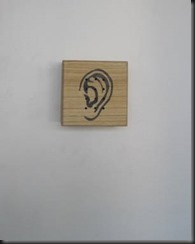
The Whisper Boxes act as complimentary stimuli when the viewer is interacting with the other pieces. They contain parts of texts and thoughts that I have in my mind when I produce the work. They are also the only surface that the viewer is “allowed” to touch.
Some excerpts are:
· All creatures in the universe
return to the point where they began.
Returning to the source is stillness, which is the way of nature.
The way of nature is unchanging.
· Knowing the constant, we accept things as they are.
By accepting things as they are, we are impartial.
By being impartial, we are part of the Nature.
· Shape clay into a vessel;
It is the space within that makes it useful.
Cut doors and windows for a room;
It is the holes which make it useful.
Therefore benefit comes from what is there;
Usefulness from what is not there.
· What lies below the surface affects the surface.
Why did you choose the Visual Arts program at the University of Victoria and how does that relate to your environmental activism?
I chose the Visual Arts program at the University of Victoria because it offers an alternative to the art education available in my country. I am being exposed to methods of creation and ways of seeing that, I believe, will allow me to develop a visual language that can communicate and create awareness about the environmental issues I consider pertinent.
I believe that art that wants to help environmental activism has to illustrate concepts in a more direct way. I don’t believe in art as propaganda or decoration. I want art that demands intellectual and emotional engagement from the viewer.
Why the shift from architecture to installation art?
I started architecture school because I was interested in landscape design. That interest was sparked by my exposure to the works of Andy Goldsworthy and Richard Long. I quickly realized that my interest in installation art was larger than my interest in designing a space for utilitarian reasons.
In 2012 I had the opportunity to participate in a collective public art action in San Pedro, Costa Rica. I was then given the advice to pursue a Visual Arts education by two artists I have much admiration for: Adan Vallecillo and Esteban Piedra Leon. Seeing their work and working with them I came to terms with the seemingly endless possibilities of exploration that contemporary art allows. After that experience my transition was simple. I still draw inspiration from architecture design studies; I rely on the planning and production methods I learned from it. I want my work to exist in between art and architecture in order to draw attention to the rich potential that exists in that space.
Is there a piece in the show that did not make it in the exhibition? If so, why?
There are pieces from other series that had potential to be in the show but they did not sustain a dialogue in the same way the current pieces do.
Do you have any photos of past works e.g. sculptures that you made in high school?
I don’t have any right now, sorry.

You mentioned that at the opening reception people were afraid to walk through and interact with the installation. Why do you think that is and do you think this would be the case in Costa Rica as well?
I believe that the installation has a precarious look to it. The people might have felt threatened to go under it. Also, if walking around the installation, the proximity between some of the rocks requires a closer distance to the pieces; this proximity might be uncomfortable to some people.
I don’t know if it would have been different in Costa Rica, I think people would be more drawn to interact with it, as there is a larger tradition of interactive art pieces in my hometown.
Any plans for your next exhibition?
My next project is a public art installation in San Jose. It will be an interactive piece composed by many hanging strands of material that people can be immersed in. It will be in the site of a weekly farmer's market so the piece will adapt to the audience and the space dynamics that occur there. It will be ready for the beginning of August 2015. I am still in the process of working out details.

the fifty fifty arts collective is a non-profit artist-run centre that provides space for artists of all disciplines who have yet to be defined in the mainstream {intimate music, art and film programming}. Hours: Monday 1-6 / Wednesday 10-6/ Friday 10-330/ Sunday 9-12 Contact: thefiftyfifty@gmail.com
‘Sergio’s exhibition provides a thoughtful inquiry into the meaningfulness of our interactions with the objects of our everyday comings and goings –reminding us of the intimacy that informs even the most banal encounters with the surfaces of the natural world.’ –Megan Dyck, artist & educator

![clip_image002[1]](https://blogger.googleusercontent.com/img/b/R29vZ2xl/AVvXsEhQH3yrcdp0QqoCKoso6oAcxrf7ql9O9wtRVIX2GeOPc6qsYknHmCRFjLRkxB039_KaVWVx3ssSxRmMpPX33yzG3eTEFI52NMpQBmCBDQHMHro8OSstl2w8gT3YXTWAltJUL7FUOU2Kusbt/s1600-h/clip_image002%25255B1%25255D%25255B2%25255D.jpg "clip_image002[1]")
Why ‘Una Superficie Tangible / A Tangible Surface’ for the title?
To me a tangible surface is one that gives a sense of volume and weight without the need of physical interaction. It is a surface that can communicate its physicality by purely observational means. Our experience of extension is made through inference: that looks heavy, that seems thick. Mass, density, volume-- we only experience these as surface.
I believe that the objects in the exhibition communicate their tri-dimensionality just by being present in the space. They have rich textures and forms that draw attention and spark interest. The gallery context dictates the relationship between the object and the viewer, it is almost normative not to touch the art. You can only interact with it visually. I take advantage of this pre-established relationship to draw closer attention to surfaces.
How did you decide on what materials to use?
I work mostly with natural or discarded materials. I choose materials that convey a sense of their origin. I choose materials that I can relate to and that relate to each other.
To make the rope I chose the natural fibre that I felt most comfortable with. I used to make hemp jewelry when I was younger so the choice was simple. The rocks were an easy decision as it is a material present in all parts of the world. Rocks are part of our history and they compose our landscape, because of this I believe they convey universality. The marble I chose because of its aesthetic beauty and traditional use in the arts. I am also interested in the fact that we only truly appreciate marble we grind its outer surface and polish it. Raw marble is not appealing to humans. Finally I chose the metal because it is something commonly discarded. I enjoy how the metal sheet I intervened reflects the natural processes that occur here on the island.

You mentioned that you wanted to create spatial awareness and allow viewers to realize the capacity of material. Do you think you achieved this?
I do think I increased spatial awareness to some extent. The Suspension Studies make the viewer aware of the dimensionality of the exhibition space (wall distance, ceiling height, spotlights, etc). The Shui- mo panels draw the viewer through the narrow space they are in. The surface intricacies and patterns on the panels are also present in Oceanscape, these details make the viewer aware of similar details on the gallery floor and walls. My intention is for people to come out of the gallery space and pay more attention to the surfaces around them.
What do the sound boxes have to do with 'tangibility' and space?
The Whisper Boxes act as complimentary stimuli when the viewer is interacting with the other pieces. They contain parts of texts and thoughts that I have in my mind when I produce the work. They are also the only surface that the viewer is “allowed” to touch.

Some excerpts are:
· All creatures in the universe
return to the point where they began.
Returning to the source is stillness, which is the way of nature.
The way of nature is unchanging.
· Knowing the constant, we accept things as they are.
By accepting things as they are, we are impartial.
By being impartial, we are part of the Nature.
· Shape clay into a vessel;
It is the space within that makes it useful.
Cut doors and windows for a room;
It is the holes which make it useful.
Therefore benefit comes from what is there;
Usefulness from what is not there.
· What lies below the surface affects the surface.
Why did you choose the Visual Arts program at the University of Victoria and how does that relate to your environmental activism?
I chose the Visual Arts program at the University of Victoria because it offers an alternative to the art education available in my country. I am being exposed to methods of creation and ways of seeing that, I believe, will allow me to develop a visual language that can communicate and create awareness about the environmental issues I consider pertinent.
I believe that art that wants to help environmental activism has to illustrate concepts in a more direct way. I don’t believe in art as propaganda or decoration. I want art that demands intellectual and emotional engagement from the viewer.
Why the shift from architecture to installation art?
I started architecture school because I was interested in landscape design. That interest was sparked by my exposure to the works of Andy Goldsworthy and Richard Long. I quickly realized that my interest in installation art was larger than my interest in designing a space for utilitarian reasons.
In 2012 I had the opportunity to participate in a collective public art action in San Pedro, Costa Rica. I was then given the advice to pursue a Visual Arts education by two artists I have much admiration for: Adan Vallecillo and Esteban Piedra Leon. Seeing their work and working with them I came to terms with the seemingly endless possibilities of exploration that contemporary art allows. After that experience my transition was simple. I still draw inspiration from architecture design studies; I rely on the planning and production methods I learned from it. I want my work to exist in between art and architecture in order to draw attention to the rich potential that exists in that space.
Is there a piece in the show that did not make it in the exhibition? If so, why?
There are pieces from other series that had potential to be in the show but they did not sustain a dialogue in the same way the current pieces do.
Do you have any photos of past works e.g. sculptures that you made in high school?
I don’t have any right now, sorry.

You mentioned that at the opening reception people were afraid to walk through and interact with the installation. Why do you think that is and do you think this would be the case in Costa Rica as well?
I believe that the installation has a precarious look to it. The people might have felt threatened to go under it. Also, if walking around the installation, the proximity between some of the rocks requires a closer distance to the pieces; this proximity might be uncomfortable to some people.
I don’t know if it would have been different in Costa Rica, I think people would be more drawn to interact with it, as there is a larger tradition of interactive art pieces in my hometown.
Any plans for your next exhibition?
My next project is a public art installation in San Jose. It will be an interactive piece composed by many hanging strands of material that people can be immersed in. It will be in the site of a weekly farmer's market so the piece will adapt to the audience and the space dynamics that occur there. It will be ready for the beginning of August 2015. I am still in the process of working out details.

the fifty fifty arts collective is a non-profit artist-run centre that provides space for artists of all disciplines who have yet to be defined in the mainstream {intimate music, art and film programming}. Hours: Monday 1-6 / Wednesday 10-6/ Friday 10-330/ Sunday 9-12 Contact: thefiftyfifty@gmail.com
Tuesday, May 19, 2015
Wednesday, May 13, 2015


Subscribe to:
Posts (Atom)