
Showing posts with label Neil McClelland. Show all posts
Showing posts with label Neil McClelland. Show all posts
Friday, September 30, 2022


Monday, May 8, 2017
Winchester Galleries, ‘Five’. May 2-27th. by Philip Willey.

Vicky Christou was born in Melbourne, Australia and immigrated to Canada in 1969. She is a graduate of the Emily Carr College of Art and Design. Her work exists somewhere between painting and sculpture. She is inspired, she says, ‘by the simultaneous happenings of visual and personal metaphorical dialogues.’
Multiple layers of impasto are protected by a woven textile grid to produce striking 3 dimensional images of light and shade.

Jeremy Mangan was born in Seattle and has spent most of his life in the Pacific Northwest. He studied at PLU in Tacoma also in Munich, Germany and New York. There is something of Rene Magritte in Mangan’s paintings. He uses a realist technique to paint recognizable objects in an unusual context thereby creating improbable landscapes and events.
“My current work explores phenomena: the unusual,
exceptional moments just on the edge of plausibility,
and occasionally beyond.” Jeremy Mangan
He has shown frequently in Tacoma and Seattle and now Victorians have a chance to see his work.

Sean Mills, a graduate of Emily Carr University, based in Vancouver, explores light and transparency using paint and plexiglass. He sees paint as both occupying and containing space. The way his works play with light and shadow makes them appear less substantial than they actually are.

Neil McClelland is from Gatineau, Quebec now living in Victoria where he teaches sessionally at UVic and Vancouver Island School of Art. Of all the artists in this show perhaps McClelland comes closest to having a political agenda. His current interest is the perfectibility of society and his striking, albeit somewhat ominous, paintings capture the current societal unease.
See:

In a lighter vein is Carollyne Yardley who is best known in
Victoria for her squirrels, cheeky little critters that appear in her paintings
in various disguises. Squirrels and masks have led to her current
preoccupation, therianthropy (the ancient belief of shapeshifting, and
animal ancestors), and theriocephaly (animal-headed humanoid forms such as the
ancient Egyptian gods Ra, Sobek, and Anubis). She has also been
collaborating with Rande Ola K’alapa. Rande is part of a new generation
of indigenous artists who are open to cross-cultural experimentation. Their show
‘Shapeshifting’ is ongoing at the Fazakas Gallery in Vancouver.

Wednesday, February 15, 2017
Saturday, February 4, 2017
Neil McClelland at Deluge Contemporary Art. Feb 3rd – Mar 4th. 2017 by Philip Willey

Neil McClelland is originally from Quebec and he graduated with
an MFA from Victoria University where he now teaches sessionally. He also
teaches at the Vancouver Island School of Art.
I first saw his paintings at Open space in a show called ‘Realities,
Follies’ curated by Lynda Gammon and Wendy Welch and remember being impressed. In
that show McClelland took the opportunity to explore the historical
relationship of Cezanne’s bathers to the kind of snapshots people like to take
on beaches. There was nothing irreverent about the paintings but it was obvious
that Cezanne was getting updated.

A similar attitude towards history was evident in a series of
paintings shown at Vernon Gallery in 2014. In this show McClelland dealt with
the way we perceive art works in a gallery setting “….exploring connections and
disconnections between the art historical tradition and contemporary, digitally-mediated
visual culture”. ‘Approaching Rembrandt’ seems to encapsulate his intentions
i.e. it’s not the actual painting that is central but the approach. In
conversation he talks a lot about perception…..or how the way we see works of
art defines who we are.

Being confronted by McClelland’s work in his Fisgard Street
studio I was struck by the unreality. There’s an elusive strangeness that made
me think of Peter Doig. The work is figurative but other-worldly. It’s a
distortion of reality but not without an underlying meaning, familiar but
remote. Like Doig, McClelland takes a
painterly approach. Take ‘The Ancient Sickness of Dreams’ for instance, a tropical
setting clearly but where? For some reason it reminds me of a scene from Paul
Theroux’s ‘Mosquito Coast’. ‘In the West the Sky Contracted’ shows a burning
building, horses, a truck, that evoke ‘Black Beauty’ by Anna Sewell.


These are personal memories of course. Our minds are full of
them waiting to be triggered. In fact the horses are a truckload of statues the
artist saw during the fire in Edmonton. He uses photographs but photographic
reality is superseded by the painting process. But what to make of ‘The Wild
State of Freedom’ where we see some sort of oneiric procession,
suited figures bearing a panoply around an arena that could be BC Place, …. what does it mean? Or ‘The Beneficent Net’ with
semi-nude people surrounding some kind of fishing net? What strange catch have
they made? ‘Everything is Being Perfected’ shows humans interacting with
nature, young men amusing themselves with turtles (though the turtles don’t
seem to be having much fun).These are symbols beneath which we sense, but can’t
quite pinpoint, some universal absolutes.


There is a consistency to these paintings. They are intriguing
precisely because they aren’t explicit and the political references aren’t
overstated. Aesthetics and dialectics are finely balanced. In conversation McClelland
talks about Utopia and Dystopia, philosophical issues that lie beneath our
everyday concerns, as being inherently political. He sees the act of imagining
futures as a political act. The paintings engage with the problems of our times
and our hopes for the future but in a subtle way. Something is wrong in
paradise. There’s a rift between culture and nature. An ominous crack in the
earth is forming next to what appears to be a tranquil painting of a swimming
pool.

It’s the possibility of human perfectibility that interests him he
says, optimism and pessimism being two sides of the same coin, which prompts me
to ask if he is optimistic. Well he isn’t gloomy he says though the omens
aren’t great. Global warming, pollution, competition for resources, super-power
rivalry, a general feeling of malaise. These are anxious times and we certainly
have a way to go before we reach Utopia. Dystopia is much more likely.
Nevertheless there is always the possibility of new beginnings.

Time, existence, human survival, these are major themes and most
of the works are correspondingly large in scale. There’s nothing timid about
them. These aren’t paintings that were made for quick sale. McClelland is
aiming higher than that. But the paintings at Deluge aren’t just physically
large they are large in scope. Perhaps even museum caliber. It would be
interesting to see how they measure up to broader exposure. Neil McClelland is
energetic and ambitious so hopefully one day we will find out.
Tuesday, January 31, 2017
Neil McClelland at Deluge Contemporary Art

Everything is Being Perfected
Neil McClelland
Neil McClelland
Opening Friday, February 3, 7pm @
Deluge Contemporary Art
Deluge Contemporary Art
Monday, February 9, 2015
Saturday, January 31, 2015
Neil McClelland at Xchanges Gallery

Bathers
by
Neil McClelland
at
Xchanges Gallery
opening reception:
Fri. Feb. 6, 2015 @ 7 pm
Artist talk: Feb. 22, 2015 @ 2 pm
In “Bathers”, Neil McClelland works through ideas about how contemporary images of people at the beach, which he sources from image-sharing sites such as Instagram, have a genealogy that traces back to the art historical tradition of the bather. McClelland’s paintings take Cezanne’s bathers as a starting point for using the visual language of painting to create bathers that exist somewhere between the past and the present, between “the art in the museum” and contemporary representations. He
seeks to convey something familiar but strange, an in-between space and hybridization that provokes questioning about how we represent ourselves now and how we
look at paintings.
Saturday, January 10, 2015
Reality Follies at Open Space by Philip Willey. Jan. 2015
The first show of 2015 at Open Space features five artists and two curators, Lynda Gammon and Wendy Welch. The catalogue begins with an observation…..
“We live in an image-world. Selfies on Facebook, instant sharing on Instagram, and photo albums on Flickr, all demonstrate our intense desire to re-present our world. Through the practice of painting, the artists in this exhibition, each in their own way, are re-presenting and interrogating the meaning of representation, and in turn, questioning our ways of perceiving reality.”
Jeremy Herndl focuses on landscape. His paintings give the sense of being created outdoors in an attempt to catch scenes glimpsed fleetingly. He is more concerned with the overall impression than with individual details and his work often borders on abstraction.

Rick Leong translates the visual language of Asian landscapes to contemporary Western formats.

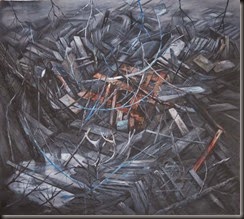
Jeroen Witvliet’s paintings look at first glance like heaps of smoldering debris interwoven with branches, antlers etc. He’s probably best known for his black and white work but the pieces at Open Space contain muted colour.
Neil McClelland’s paintings of bathers manifest a Cezanne- like interest in form and planes.

Some may remember Todd Lambeth’s paintings of cats at Deluge Gallery. This new series of paintings shows the backside of paintings. It makes for a somewhat coy statement. Not as powerful as the NYPD turning their backs on the mayor perhaps but it hints at some kind of negation or reluctance to specify the content.We have to imagine it.

This being a group show one looks inevitably for associative elements. So what is the common thread here?
They are all painters. And they all deal with representation in the sense that they use recognizable subject matter, as distinct from abstraction which so often relies on titles for reference points. Beyond that there is an unrestricted plein air feeling to the whole show that suggests an empathy for landscape. There is a perceptive essay by Wendy Welch in the catalogue which explains the concept behind the show…
‘Realities Follies questions how the real can be represented in painting through form and process….Reality in a painting can move from objective images of the world to subjective constructs based on the physical experience of creating the work’.
Not to downplay Welch’s thesis but the same can be said of sculpture, photography and even conceptual art. All art forms in fact can and do go beyond representation. Still in this context she is making a case for painters having more physical control of the reality they choose to represent as opposed to the reality of photography. She admits a consensus on what reality is might be hard to come by but she sees painters ‘letting imagination, memory and the painting process itself direct the end result’.
She describes Herndl’s paintings for instance as a kind of shorthand, a meditation on light, forms and colour whereas Leong creates a fantastical reality rom hybrid sources, Lambeth questions the nature of painting, McClelland takes a historical approach, and Witvliet speaks of survival.
Welch expands on these ideas in another essay on the VISA website.* In this essay she talks about a rebirth of painting. (Some among us would say it never died but that’s a separate debate). In an age of saturation by photo-based images Welch considers painting as relevant as it ever was. Perhaps more so.
The curators want to inspire us to make sense of our own reality. Have they been successful? The show runs until Feb 21st. so go to Open Space and decide for yourself.
The artists and curators will meet in a panel discussion on Saturday, January 17 at 2:00 pm. at Open Space.
· http://tinyurl.com/n7pdf4f
“We live in an image-world. Selfies on Facebook, instant sharing on Instagram, and photo albums on Flickr, all demonstrate our intense desire to re-present our world. Through the practice of painting, the artists in this exhibition, each in their own way, are re-presenting and interrogating the meaning of representation, and in turn, questioning our ways of perceiving reality.”
Jeremy Herndl focuses on landscape. His paintings give the sense of being created outdoors in an attempt to catch scenes glimpsed fleetingly. He is more concerned with the overall impression than with individual details and his work often borders on abstraction.

Rick Leong translates the visual language of Asian landscapes to contemporary Western formats.

Jeroen Witvliet’s paintings look at first glance like heaps of smoldering debris interwoven with branches, antlers etc. He’s probably best known for his black and white work but the pieces at Open Space contain muted colour.

Neil McClelland’s paintings of bathers manifest a Cezanne- like interest in form and planes.

Some may remember Todd Lambeth’s paintings of cats at Deluge Gallery. This new series of paintings shows the backside of paintings. It makes for a somewhat coy statement. Not as powerful as the NYPD turning their backs on the mayor perhaps but it hints at some kind of negation or reluctance to specify the content.We have to imagine it.

This being a group show one looks inevitably for associative elements. So what is the common thread here?
They are all painters. And they all deal with representation in the sense that they use recognizable subject matter, as distinct from abstraction which so often relies on titles for reference points. Beyond that there is an unrestricted plein air feeling to the whole show that suggests an empathy for landscape. There is a perceptive essay by Wendy Welch in the catalogue which explains the concept behind the show…
‘Realities Follies questions how the real can be represented in painting through form and process….Reality in a painting can move from objective images of the world to subjective constructs based on the physical experience of creating the work’.
Not to downplay Welch’s thesis but the same can be said of sculpture, photography and even conceptual art. All art forms in fact can and do go beyond representation. Still in this context she is making a case for painters having more physical control of the reality they choose to represent as opposed to the reality of photography. She admits a consensus on what reality is might be hard to come by but she sees painters ‘letting imagination, memory and the painting process itself direct the end result’.
She describes Herndl’s paintings for instance as a kind of shorthand, a meditation on light, forms and colour whereas Leong creates a fantastical reality rom hybrid sources, Lambeth questions the nature of painting, McClelland takes a historical approach, and Witvliet speaks of survival.
Welch expands on these ideas in another essay on the VISA website.* In this essay she talks about a rebirth of painting. (Some among us would say it never died but that’s a separate debate). In an age of saturation by photo-based images Welch considers painting as relevant as it ever was. Perhaps more so.
The curators want to inspire us to make sense of our own reality. Have they been successful? The show runs until Feb 21st. so go to Open Space and decide for yourself.
The artists and curators will meet in a panel discussion on Saturday, January 17 at 2:00 pm. at Open Space.
· http://tinyurl.com/n7pdf4f
Friday, January 9, 2015

Wednesday, October 22, 2014

Subscribe to:
Posts (Atom)