
Showing posts with label Jeroen Witvliet. Show all posts
Showing posts with label Jeroen Witvliet. Show all posts
Sunday, October 30, 2016


Tuesday, May 5, 2015

Saturday, January 10, 2015
Reality Follies at Open Space by Philip Willey. Jan. 2015
The first show of 2015 at Open Space features five artists and two curators, Lynda Gammon and Wendy Welch. The catalogue begins with an observation…..
“We live in an image-world. Selfies on Facebook, instant sharing on Instagram, and photo albums on Flickr, all demonstrate our intense desire to re-present our world. Through the practice of painting, the artists in this exhibition, each in their own way, are re-presenting and interrogating the meaning of representation, and in turn, questioning our ways of perceiving reality.”
Jeremy Herndl focuses on landscape. His paintings give the sense of being created outdoors in an attempt to catch scenes glimpsed fleetingly. He is more concerned with the overall impression than with individual details and his work often borders on abstraction.

Rick Leong translates the visual language of Asian landscapes to contemporary Western formats.

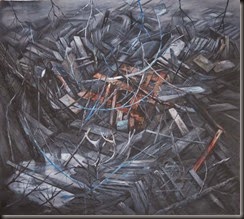
Jeroen Witvliet’s paintings look at first glance like heaps of smoldering debris interwoven with branches, antlers etc. He’s probably best known for his black and white work but the pieces at Open Space contain muted colour.
Neil McClelland’s paintings of bathers manifest a Cezanne- like interest in form and planes.

Some may remember Todd Lambeth’s paintings of cats at Deluge Gallery. This new series of paintings shows the backside of paintings. It makes for a somewhat coy statement. Not as powerful as the NYPD turning their backs on the mayor perhaps but it hints at some kind of negation or reluctance to specify the content.We have to imagine it.

This being a group show one looks inevitably for associative elements. So what is the common thread here?
They are all painters. And they all deal with representation in the sense that they use recognizable subject matter, as distinct from abstraction which so often relies on titles for reference points. Beyond that there is an unrestricted plein air feeling to the whole show that suggests an empathy for landscape. There is a perceptive essay by Wendy Welch in the catalogue which explains the concept behind the show…
‘Realities Follies questions how the real can be represented in painting through form and process….Reality in a painting can move from objective images of the world to subjective constructs based on the physical experience of creating the work’.
Not to downplay Welch’s thesis but the same can be said of sculpture, photography and even conceptual art. All art forms in fact can and do go beyond representation. Still in this context she is making a case for painters having more physical control of the reality they choose to represent as opposed to the reality of photography. She admits a consensus on what reality is might be hard to come by but she sees painters ‘letting imagination, memory and the painting process itself direct the end result’.
She describes Herndl’s paintings for instance as a kind of shorthand, a meditation on light, forms and colour whereas Leong creates a fantastical reality rom hybrid sources, Lambeth questions the nature of painting, McClelland takes a historical approach, and Witvliet speaks of survival.
Welch expands on these ideas in another essay on the VISA website.* In this essay she talks about a rebirth of painting. (Some among us would say it never died but that’s a separate debate). In an age of saturation by photo-based images Welch considers painting as relevant as it ever was. Perhaps more so.
The curators want to inspire us to make sense of our own reality. Have they been successful? The show runs until Feb 21st. so go to Open Space and decide for yourself.
The artists and curators will meet in a panel discussion on Saturday, January 17 at 2:00 pm. at Open Space.
· http://tinyurl.com/n7pdf4f
“We live in an image-world. Selfies on Facebook, instant sharing on Instagram, and photo albums on Flickr, all demonstrate our intense desire to re-present our world. Through the practice of painting, the artists in this exhibition, each in their own way, are re-presenting and interrogating the meaning of representation, and in turn, questioning our ways of perceiving reality.”
Jeremy Herndl focuses on landscape. His paintings give the sense of being created outdoors in an attempt to catch scenes glimpsed fleetingly. He is more concerned with the overall impression than with individual details and his work often borders on abstraction.

Rick Leong translates the visual language of Asian landscapes to contemporary Western formats.

Jeroen Witvliet’s paintings look at first glance like heaps of smoldering debris interwoven with branches, antlers etc. He’s probably best known for his black and white work but the pieces at Open Space contain muted colour.

Neil McClelland’s paintings of bathers manifest a Cezanne- like interest in form and planes.

Some may remember Todd Lambeth’s paintings of cats at Deluge Gallery. This new series of paintings shows the backside of paintings. It makes for a somewhat coy statement. Not as powerful as the NYPD turning their backs on the mayor perhaps but it hints at some kind of negation or reluctance to specify the content.We have to imagine it.

This being a group show one looks inevitably for associative elements. So what is the common thread here?
They are all painters. And they all deal with representation in the sense that they use recognizable subject matter, as distinct from abstraction which so often relies on titles for reference points. Beyond that there is an unrestricted plein air feeling to the whole show that suggests an empathy for landscape. There is a perceptive essay by Wendy Welch in the catalogue which explains the concept behind the show…
‘Realities Follies questions how the real can be represented in painting through form and process….Reality in a painting can move from objective images of the world to subjective constructs based on the physical experience of creating the work’.
Not to downplay Welch’s thesis but the same can be said of sculpture, photography and even conceptual art. All art forms in fact can and do go beyond representation. Still in this context she is making a case for painters having more physical control of the reality they choose to represent as opposed to the reality of photography. She admits a consensus on what reality is might be hard to come by but she sees painters ‘letting imagination, memory and the painting process itself direct the end result’.
She describes Herndl’s paintings for instance as a kind of shorthand, a meditation on light, forms and colour whereas Leong creates a fantastical reality rom hybrid sources, Lambeth questions the nature of painting, McClelland takes a historical approach, and Witvliet speaks of survival.
Welch expands on these ideas in another essay on the VISA website.* In this essay she talks about a rebirth of painting. (Some among us would say it never died but that’s a separate debate). In an age of saturation by photo-based images Welch considers painting as relevant as it ever was. Perhaps more so.
The curators want to inspire us to make sense of our own reality. Have they been successful? The show runs until Feb 21st. so go to Open Space and decide for yourself.
The artists and curators will meet in a panel discussion on Saturday, January 17 at 2:00 pm. at Open Space.
· http://tinyurl.com/n7pdf4f
Friday, January 9, 2015

Wednesday, October 22, 2014

Sunday, April 6, 2014

Friday, September 21, 2012
V.I.S.A. Faculty exhibition at the Slide Room Gallery

Vancouver Island School of Art - Faculty Exhibition
Work by Rachel Hellner, Jeremy Herndl, Danielle Hogan, Todd Lambeth, John Luna, Tracey Nelson, Tara Nicholson, Jenn Robins, Xane St Phillip, Marie Ulber, Wendy Welch and Jeroen Witvliet.
Opening Reception : Sept. 21, 2012 @ 7:30 pm
The Slide Room Gallery
2549 Quadra St.
Exhibit ends Nov. 5, 2012
Thursday, September 13, 2012
Jeroen Witvliet show “Days” reviewed by Debora Alanna


Entering Days, Jeroen Witvliet’s epic drawings loom, overpower any thought brought to the Slide Room Gallery threshold, drawing one completely into his disquieting and imposing work. Drenched with charcoal biting stark, thick white paper, attentively drawn distressed entanglements emphasize spectacle, vistas of loaded feelings conspicuous in heaps of tousled matter and defeated branches. There is a line in Aristotle’s poetics Part IV that this work embodies, ‘Objects which in themselves we view with pain, we delight to contemplate when reproduced with minute fidelity’. ([1]) With commitment to detail, Witvliet produces contemplative stanzas of a tragic poem. Days drawings are knotty discussions about ruin providing startling lucid factious narratives. His imagery taunts our perception of how days of time influence disaffecting internal conflicts.
Unlike Webster and Noble's trash pieces that create coy figurative shadows projected from the waste configuration, Witvliet’s debris piles, although seemingly rendered as haphazard, are judicious figuration explorations as well as suspended ground, a composite relation. With the intensely described veneer of ruin the remnants of civilization’s abandon and forestal foray figuratively repose as mounds. Versed in quantification and evaluation of remains, Days untitled drawings exhibit a range of possibilities for correlated dissemination, while considering its impact, and resolve, heroically complex.
From Russell Perkins', Adorno's Dreams and the Aesthetic of Violence. Telos 155 (Summer 2011). :
Adorno is never merely a passive bystander to suffering. [...] we see that insight into violence only becomes possible when neutrality is foregone for standpoints of ambivalent participation, and thus that the suspension of the category of witness becomes the very condition of possibility for testimony.
Theodor W. Adorno, (1903 –1969), German sociologist, philosopher and musicologist, known for his critical theories of cultural industry, with Max Horkheimer (1895–1973), had insight into the passive danger imposed on human needs by mass consumption.([2]) Compositional vocabulary, whether sound or visual composition, relates the audience to cultural dissonance when presented with intense scenarios as seen in Days. An Adorno like metaphor, the passivity of elegant debris ambivalently engages is a witness to violent disregard, a poignantly portrayed testament - Schoenbergian atonality personified. With Days, we see that Witvliet also is not a bystander to suffering because his work is a demonstration of universal untamed forces that disseminate within us all. Days is evidence, imagery dishevelled with violent overtones.
Witvliet’s Days has uncanny erotic tension within the load of implicit piles of expressive remnants’ and/or broken branches coexisting, memories upon memories tangled. In Ralf Waldo Emerson’s poem, Days, he speaks of his ‘pleached’ garden. Witvliet’s pleached wreckage, woven with civilization’s discard and denuded trees is the Garden, reverential intimacy scorned. The politics of duplicity is inscribed in the torn and stinging lines he makes whipping up from the white paper wasteland, spilling shadow.
Orgone, Reich & Eros, Wilhelm Reich’s Theory of Life Energy by W. Edward Mann, on page 159, quotes from an article by Richard Martin, “Be Kind to Plants – Or You Could Cause a Violet to Shrink,” in The Wall Street Journal, Wednesday, February 2, 1972 to substantiate Reich’s claim that ‘orgone energy pulsates through all living systems and that all are interdependent, existing in a kind of energy ocean.’ Wilhelm Reich called his hypothesized universal life force orgone. He claimed orgone is imparted from all organic material, which ostensibly can be captured with a booth-like device to restore psychological health.
Two of Witvliet’s drawings are plants under glass, or see-through boxes and there is another drawing of a seemingly abandoned greenhouse snugly enclosed by a mishmash of forest debris – the residual forest darkness standing distant. Hans Haacke's "Condensation Cube" (1963), displays transformative energy as condensation, collected or at least contained, without vegetation because Haacke has transplanted weather indoors, detached from growth, and presumably orgone. Witvliet’s greenhouse rendering, with this theory, is a very big organic energy collection box with a spiritual aesthetic seen in Gerhard Richter’s Iceberg in Fog (Eisberg im Negel) (2002). Human interaction has forced the forest surround into submission, while the trees still stand behind the greenhouse are expectant reminders of how energy can be cultivated, although, directed by human foible amassed energy can also abuse, destroy. Witvliet measures our collective psychological health and tells us the forest is shrinking, and our energy ocean is as segregated and minimal as a Haacke condensation cube. This is not a theory.
In a video performance, a reinvention of Allan Kaprow’s Art is Life (1964/2008), at The Museum of Contemporary Art, Los Angeles (MOCA) presented by Outpost for Contemporary Art on April 19, 2008, a segment called “Household Revisited”, where (according to MOCA) ‘Peaceniks, Treehuggers and other Believers’, in the midst of household debris (some human size), chant:
We lie where we will
What if every cell in our body is in dialogue with all there is?
Imagine the world you can’t imagine.
Imagine being accepted.
Junk, piles of people.
Household remnants strewn and piled in a field was a rebellion against the accoutrements of banality, while the Believers implore for liberation from the idea that people represent themselves by what they own. Witvliet’s immobilized masses of liberated stuff, many pieces laded in handsome adjacent squares, networks of distribution, and even muddled masses spare the association of ‘Junk, piles of people’. Figurative, yes, but his imagination has been long liberated from literal references, enabling mottled shreds of interactions to blanket the mounds.
On 11 September 2012, The UK daily, the Telegraph reported ([3]),”the massive floating islands of garbage, some almost 70 miles in length, caused by last month’s tsunami in Japan, which are causing chaos in shipping lanes in the Pacific Ocean, as they slowly head for the west coast of the America.” As Witvliet’s piles seem to float, they do incite a kind of chaos, blockage, a revelation of a disturbance and trauma. In his artist statement, he refers to the image within his refuse drawings as, “A raft lost at sea.”
In Jorge Luis Borges’ preface to "The Invention of Morel", a novel by Adolfo Bioy Casares, about an island of intrigue, he writes that full freedom leads to full disaster, global warming’s weather demise contributing, as the news item above attests. What Borges calls the fictitious nature of politics as a means to freedom through the ordering of society is punishingly unable to originate mysterious, and reasonable facts the author, Casares can contrive. We have to wonder about the politics of materialism that the floating ocean island of debris in the news above created, and what disorder allows the menace to continue to pollute. Witvliet’s islands of dishevelled matter are the result of unrestrained loads, where chaos has created the enigma of mess and confusion. What Witvliet creates is a delicate wisdom, as Borges would say, to transcribe intangible, mysterious veracity. Magritte said, ‘The mind loves the unknown. It loves images whose meaning is unknown, since the meaning of the mind itself is unknown.” ([4]) Witvliet, akin to Borges’ Casares, renders the unknown as archetypal insight and with his mindful power of depiction, articulates the mysterious with demonstrative candour.
In Edgar Allen Poe’s poem, Enigma, hiding the name of a fellow poet in its text, to express how she was unacknowledged in her lifetime, he writes, “through all the flimsy things we see at once”[...]”Trash of all Trash”. [...]”But this is now – you may depend upon it –/Stable, opaque, immortal – all by dint/Of the dear names that he concealed within’t.” The enigma, here being the baffling unknown reason his friend’s poetry was not recognized in spite of her profundity. Witvliet’s drawings, too are veiled gems, enigmatic discourses on life’s inconsistency and the mortal need for rapport. As we, with ambivalence render our vision opaque, we are reticent to see the concealments of powerful, universal truths in perilous collections of thought as his piles of debris describe. Witvliet’s Days is significant, enduring memory that pictures weighted introspection. His denouement of our collective tragedy, the revelation is confrontational pain. Through the mourning of Days, we are wakening.
[1] http://classics.mit.edu/Aristotle/poetics.1.1.html
[2] Adorno, T. W., with Max Horkheimer. Dialectic of Enlightenment. Trans. Edmund Jephcott. Stanford: Stanford UP, 2002. 242.
[3] http://www.telegraph.co.uk/news/worldnews/asia/japan/8437632/Massive-floating-rubbish-islands-from-Japan-tsunami-spotted-on-Pacific.html
[4] René Magritte (1898-1967), Belgian surrealist painter. Quoted in Suzi Gablik, Magritte, ch. 1 (1970).
Slide Room Gallery
Vancouver Island School of Art
Victoria BC
August 2012
Jeroen's website : www.structure365.com
Saturday, August 25, 2012
" Days" by Jeroen Witvliet at The Slide Room Gallery
Recently I have focused on debris piles and their ambiguous
origins.
The piles are recognized to be accumulations of a history that
might still be visible or might be obscured. The situation that led to the
formation of the pile has become an enigma. If anything they have become an
abstraction. In the forms and shapes landscapes can be discovered, the remnants
of events and situations become landscape. Faint echoes of shelters, ribs,
pallets, trees all create a sense of the presence of a raft. A raft lost at
sea.
Images collected of a wide range of piles are being used as a
starting point for the paintings and drawings. Information is being added or
removed. Barricades erected in the streets become in disguisable from
construction site materials left after the building of houses. Humans are
removed from the scenes to further strengthen the removal from direct
reference. All drawings and paintings are now done from memory.
I seem to always question the position of a perceived fixed
point in time. Quickly realizing that information is constantly being
reinterpreted and new meaning and readings can be attached to both the
personal, a historical event and a work of art.
I have been intrigued by the way piles, statues and memorial
sites are a result and expression of a time bound, subjective interpretation of
history.
Temporary events are constantly related to and measured against
previous situations, history and art history.
Events, especially current, seem the last hooray of an incubation
period. Or at least that is the feeling I get. Images of barricades thrown up
in the street seem to talk about the tensions that grew under the surface,
accumulating in a reaction.
The rise and fall of political systems might be seen as
mirroring the growth seasons.
While working on ideas in a studio, the creative process seems
to be responsive to the world and informed by a similar incubation period.
When painting and drawing greenhouses I am creating sheltered
situations. These are structures that protect and nourish seedlings. My
approach is one of lyricism, using the structures as symbols. In them I create
situations that are sometimes poetic, sometimes unbelievable. I am giving
myself the freedom to manipulate what grows inside of them to the extend that I
feel is necessary to make a drawing or painting that questions more then it
answers.
Exhibit runs until Aug. 31, 2012
Slide Room Gallery
2549 Quadra St. Victoria, B.C.
Phone: 250-380-3500
Phone: 250-380-3500
Wednesday, August 1, 2012


Monday, January 2, 2012
Jeroen Witvliet – January 2012 – Artist of the Month
 |
| Statue, oil on wood 2011 18 x 14 inches |
The paintings of Jeroen Witvliet respond to current events and happenings that find their roots in the past but shape our future. Without loosing a sense of the poetic, Jeroen's work explores the relationship between the materiality of paint, the failures of self and society.
He is intrigued by the way information is stored, manipulated and used for a plethora of different purposes and how this informs his own world view. The artist seems to be trying to discover parallels with past events in order to find some solace in the notion that maybe nothing is new and that there is a way to make sense of the world by regarding history as definite. Alas, his work shows a doubtful approach to the use of history. Recognizing that our perceived knowledge of the world has accumulated into a massive register of manipulations and falsification of the direct experience. Information has been layered, designed and obscured to aid and fit any agenda. By manipulating our ideas of public spaces, questioning media footage and creating fake monuments Witvliet's work engages in generating a dialogue between, perception, actuality and history.
www.jeroenwitvliet.blogspot.com
www.structure365.com
Subscribe to:
Comments (Atom)