(
Part 1 – Interview with Connie Morey)
The Posthuman Condition is a way of describing human nature at this time in our history. It refers to a period after Humanism in which humans can no longer be regarded as unique, distinct from or superior to the world around them. Consequently we must adapt our understanding of the nature of mind, reality, and what it is to be human.~ ROBERT PEPPERELL [1]
Kiki Smith
A Diary of Fluids and Fears (Interview by Francesco Bonami) (1993)
[2]
KS:
What is inside you is about your history. Your body is like a mandala, you focus on a point and you see all the connections surrounding it.
FB:
In the end your works are like body fluids: you create an equivalence.
KS:
They express what I am in the same way. They are not trying to prove anything except that I am here, and what I care about. They create a panorama where everything is connected to yourself.
Connie Morey’s exhibition,
ba_ble: inarticulations on human-animal relations is an articulate development of her syntax, relational devices to explain the overlap and integration of poetic observations through the language of painted and sculptural investigations of being. She asserts that everything is connected to everything else – human to animal, especially. What we cannot see in our psychic and spiritual existence is presented. Her/our relationship with animals is an example with how we may coexist within the presence non-verbal dialogue, how we can discover and concede the animal nature within human existence. Morey combines visceral experience with questions about the unfathomable relating
ba_ble with animals’ use of communication. Crafting emollient visual descriptions of experience,
ba_ble incorporates the assault and inundation through reference to animal sensibility and substance to address the need to be attentive to animal eloquence, their seminal significance for our relations. Her work is pervasively intimates sanguinity (courage, hope, passion) and humour, but the blood allusions are dry. Ba_ble strives for hope with beatific colour, seductive animal metaphors, fur and feather challenging persistent, enveloping melancholia. Morey preens and feathers our sensibilities through promising symbiotic interconnectivity.
You cannot answer Berkeley, even if you have annihilated Kant, and yet, perforce, you assume that Berkeley is wrong when you affirm that science proves the non-existence of God, or, as much to the point, the existence of matter. - You know I granted the reality of matter only in order to make myself intelligible to your understanding. Be positive scientists, if you please; but ontology has no place in positive science, so leave it alone. ~ From
Martin Eden by Jack London,
Martin Eden >

Chapter XXXVI. The Free Library.
A very rudimentary definition, ontology, the metaphysics of being (not domain hierarchy and other parameters included in computer science), opposes phenomenology, the philosophy base that investigates reality consisting of objects and events that form human consciousness rather than anything that is not experienced or independent of consciousness, (metaphysics considered assumptions by phenomenologists) has been an age old query recorded through philosophers delving into this deliberation of the essence of being from Aristotle to Connie Morey’s work, ba_ble.
[3] Morey confidently embraces ontological premises, exploring the elusive and ethereal experientially. For her, matter matters, has intelligence, sensory capability and responds to complex existence. Consciously we experience unconscious embodiment in Morey’s work.
 "Dysphonia (Mouth Stuffed Full)"; 2011-2012; clay slip, glaze, graphite & fur; dimensions variable
Photo courtesy Connie Morey
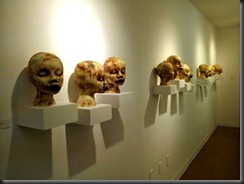 Dysphonia (Mouth Stuffed Full)
 [Installation]
Photo Courtesy Debora Alanna
...the kind of invention that is necessary to make a general scheme is limited in everybody’s experience... that is, if you like, repetition, that is if you like the repeating that is the same thing, but once started expressing this thing, expressing anything there can be no repetition because the essence of that expression is insistence, and if you must insist you must each time use emphasis and if you use emphasis it is not possible while anybody is alive that they should use exactly the same emphasis. ~ Gertrude Stein, “Portraits and Repetition” in Lectures in America, 1935.
Dysphonia. Difficulty in speaking usually from a disorder, damage, or malformation. Morey’s group of heads are hushed, insisting complacency in unison, an emphasised distress. Creamy stained darkly unvarying countenances, unseeing, smoothly nude, except for scribbling; with a tuft of fur in their mouths, and some tufting bloodied red incapacitate speech. Silenced by unspeakable violation or is the self abasement the breach? Eyes closed, the distorted writing, staining is the only indication of thought or emotion. Multiple heads as a collective blind passivity? Morey’s rejoinder to passive fury? Furry thoughts? Silence of the furred? Each of the multiplied sameness is on varied levels, poised in various directions, so we can see different views of dysphasia embodied, dysphasia because there is failure to respond involved here. What is about fur in a human mouth that is discomfiting? A mouth would feel full of animal covering, protection choking, blocking the orifice of pleasure, of breath, of sustenance and vehicle for speech, disturbing, disrupting articulation. Morey’s heads seem impervious, except for the scribbles. She shows animal smother imposed. Possibly self imposed. Fur that draws us to animals has enabled a withdrawal of spirit when a gag is imposed. Mouths jammed to capacity with mammalian coating do make speaking difficult. No furry wag, here.
Dysphonia is harried thought processes made inarticulate.
 Embodiment: (Stomach Growls)
Clay slip, glaze, & fur 2011 – 2013
Photo courtesy Connie Morey
... the synthesis which constitutes the unity of the perceived objects and which gives meaning to the perceptual data is not an intellectual synthesis. ... it is a “synthesis of transition”. ~ Maurice Merleau-Ponty, ‘The Primacy of Perception and Its Philosophical Consequences’
[4]
The attribution of significance doesn’t depend on pure intellect which, in examining things analytically, attributes meaning and objective values which morals have incessantly imposed upon us. The attribution of significance depends on the body which, coming into the world and growing up under given circumstances, is provided with a certain meaning and certain value and so feels things differently. The body does not receive the action of things; the action is only the significance that the body attributes to things. ~ Uberto Galimberti,
Il Corpo (The body), Milan, 1987, p. 114.
A diminutive ceramic male torso sequestered to a corner is half blind, with musculature and organs revealed on his head and throat, inner thigh. His abdomen is fur.
Embodiment: (Stomach Growls) is a contentious
discussion about perception and relationship inference. The relating begins with the animal impetus within human existence challenging human conditioning to ignore our animal selves, while we embody the intimidating constitution of animal sensations or changes in bodily functions. Fur becomes intention and objective synthesis transitioning towards the stigma of animal appetite.
The logic of imposed physicality is countered with the opposition of nonverbal growling as interaction. Illogicality of a fur front on a human is a metaphor for an animalistic presence, the furring symptom of the bestial self - a synthesis or manufactured perception of an entirety. A furred centre, an engrossing vigour, the concentration on instinctive drives is exemplified. The male’s indifference or oblivion to his innate nature is as obvious as the bare muscles or brain exposure, yet somewhat perceiving the dispensation, the release from his obligation to people, to himself with one eye open. If he was obliged to suppress the animal side of his nature, he is no longer able, or willing. Synthesis of self, the fusion of logic and desire Morey describes with this smooth blue creviced (bruising of cognisance) whitened man is a paradoxical existence, where perception of human nature is an explicit, but transitional discourse towards a preoccupation with the struggle between spiritual and instinctive existence. Morey truncates the torso at the genital area, a dipping of the belly to cover or to hide the absence of sexual functionality. The downward glance from the unemotional figure is a gesture, an amorphous nod to dismiss any import. He doesn’t seem to care about the extent or quality of his humanity, or inhumanity. Through Morey’s segregation of the figure from the rest of the exhibition, and the fur furore, reflexive of imposed morality correspond to a judgement that relegates animalistic appetites as intrusion.
Embodiment: (Stomach Growls) superimposes the synthesis of animal and human appetites, which is entirely human, whether the figure cares or not.
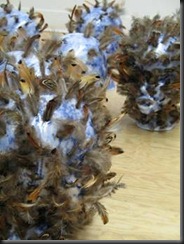 "Osmophonia (The Porosity of Song)"; 2012-2013; clay slip, glaze, & feathers; dimensions variable
Photo courtesy Connie Morey

 Osmophonia (The Porosity of Song)
 [installation and detail]
Photos courtesy Debora Alanna
Form ceases to be an ordering in time like ABA and reduces to a single, brief image, an instantaneous whole both fixed and moving... ~ Roger Shattuck,
The Banquet Years, 1955.
The smell of sound or the impulse or osmosis of sound,
Osmophonia (The Porosity of Song) is a group of heads as single multiplex, like an agogic music composition, choralistic. Each choral contributor stressed a little differently. Complex thought with pretty flightless feathers impaled into the idealized sky blue ceramic move us to fixation. All over. Not just as headdresses, but all over the heads and faces - noses, mouths, eyes, and necks of several heads with different numbers of feathers situated. Numerous, the works goad, and not impulsively. Compulsively. These heads are tricky, because of the distraction of the captivating mottled blue colour heads, and the delicacy, the modulations of the salubrious feathers. The birdsong may have once been a gradual, unconscious thought slowly changing the brain of the singer(s), overcome by bird song, absorbing. A culmination of desire and mystery. The penetrations of spiky plume cores marking the pores, the sores, the holes for the porosity of vocalized musicality, sensations once an observable impetus now, with the bird feathers piercing and stabbing, sounds of provocation drive irrationally. This work does not present heads porously imbibing a bird’s sensibilities, adopting a bird’s beauteous qualities, as their song, or their plumage decoratively. This work is a song of oppression, the suffocation of personality where the idea, the fragrance of singing a delicate bird warble is all that remains of the female osmoceptor. Absorption of otherness is a fait accompli. Morey shows subjugation is vociferous, hard headed.
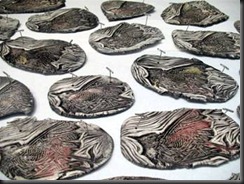 "Language as Longing: earthenware, glaze and dissection pins, dimensions variable, 2010
Photo courtesy Connie Morey
―
Neil Gaiman,
Good Omens:
‘On Eternity:
I mean, d'you know what eternity is? There's this big mountain, see, a mile high, at the end of the universe, and once every thousand years there's this little bird-"
"What little bird?" said Aziraphale suspiciously.
"This little bird I'm talking about. And every thousand years-"
"The same bird every thousand years?"
Crowley hesitated. "Yeah," he said.
"Bloody ancient bird, then."
"Okay. And every thousand years this bird flies-"
"-limps-"
"flies all the way to this mountain and sharpens its beak-"
"Hold on. You can't do that. Between here and the end of the universe there's loads of-" The angel waved a hand expansively, if a little unsteadily. "Loads of buggerall, dear boy."
"But it gets there anyway," Crowley persevered.
"How?"
"It doesn't matter!"
"It could use a space ship," said the angel.
Crowley subsided a bit. "Yeah," he said. "If you like. Anyway, this bird-"
"Only it is the end of the universe we're talking about," said Aziraphale. "So it'd have to be one of those space ships where your descendants are the ones who get out at the other end. You have to tell your descendants, you say, When you get to the Mountain, you've got to-" He hesitated. "What have
they got to do?"
"Sharpen its beak on the mountain," said Crowley. "And then it flies back-"
"-in the space ship-"
"And after a thousand years it goes and does it all again," said Crowley quickly.’
Ovoid, rounded elliptically, each work in this collection of deferential presages give presence to the ache of birthing, of the not quite born, the longing for life. The life of thought. A peek at birds still in their eggshells, without the egg. The lines around the birds conform to the bird shapes, caressing and differentiating the yet unuttered. What cannot be voiced, when in suspended formation. Wind lines flying over and around. Red of emergence tints and maybe contaminates with demise, if this is a life cycle in the other direction. These could be birds dead in their containment. These birds are pinned for inspection, with dissection pins. Investigation of the raison d’être (reason for existence), of birds. Birds with wings poised to fly, mired, or nascent with possibility. Time flies.
[5] Maybe a collection of memories of birds’ flight, journeys. Birds marking memory. Many memories collected in mountainous formation, an elevated horizon. As if they are formed to remember where they have been. Wanting to fly again, eternally.
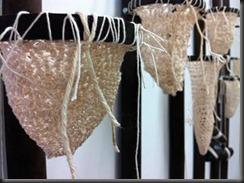 "Small Bird Trap (Learning to Sing)"; wood, crocheted string, stain; 2011-2012; dimensions variable; collaborative work with Christina & Irvin Morey
Photo courtesy Connie Morey
 Small Bird Trap (Learning to Sing)
 [Installation]
Photo courtesy Debora Alanna
Heart’s blood and bitter pain belong to love,
And tales of problems no one can remove;
Cupbearer, fill the bowl with blood, not wine -
And if you lack the heart’s rich blood take mine.
Love thrives on inextinguishable pain,
Which tears the soul, then knits the threads again.
A mote of love exceeds all bounds; it gives
The vital essence to whatever lives.
But where love thrives, there pain is always found;
Angels alone escape this weary round -
They love without that savage agony
Which is reserved for vexed humanity.
~
فرید الدین عطار, (Farid ud-din Attar).
The Conference of the Birds.[6]
Cunning, elegantly complex and varied, somewhat heart shaped crocheted bird traps mounted on smooth dark poles with faulty perches to waylay birds, shiny slim dead-weight stones tied to the trappings ensure the encapsulation, full round interwoven mouths would enable birds’ confinement, arranged capture. For future consequence. For the thrall, birds that will be caught. Voicing their hearts’ desire, to escape. This work is a metaphor for love’s stratagem. How the heart’s strings capture what is wild, hope designing, concealing devices for arresting, securing birds’ song expanse. The untamed but coveted possibilities emulating bird song allure are exemplified in this work. Yearning for sources in air is priming for the fall. Stones weighing the waiting, the trapping mouths the song. Why can birds do what human hearts cannot? Setting traps for the impossibility of bird capture, encapsulating bird characteristics, is the song of vexation. We learn to sing by capturing nothing, trapping nothing. Morey’s traps are empty. The pain of longing, waiting, which here is for birds to be trapped is on a level pegging to the deception of hearts trapping. Learning to sing is the freedom of heart’s desire to never to be trapped, even if the traps are confected delicate and intriguing.
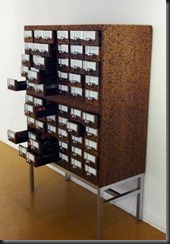 "Taxonaphonia" (DETAIL), Library cabinet, pyrographied letters, faux fur, thread and paper, 2012-2013
Photo courtesy Connie Morey
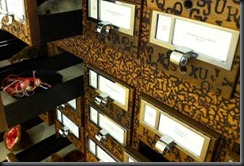 Taxonaphonia
 – Detail
Photo courtesy Connie Morey
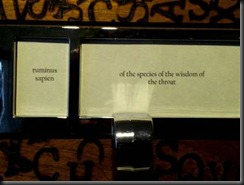 Taxonaphonia
 – Detail
Photo courtesy Debora Alanna

 Taxonaphonia
 – Details
Photos courtesy Debora Alanna
I am for the art of conversation between the sidewalk and a blind mans metal walking stick. ~ Robert Rauschenberg. From “I am for an art...” from
Store Days, 1967.
Connie Morey, on her website about
Taxonaphonia:
taxon -
from taxonomy
from the Greek táxis - 'arrangement', 'management' & nomíā ,
related to nómos - 'law'
(taxonomy, n.d.)
aphonia-
from the Greek aphōnos - ‘voiceless’, 'without voice'
(aphonia, n.d.)
Wisdom, a unique human attribute rich in history dating back to the dawn of civilization, is a newcomer to the world of empirical research. For centuries, wisdom was the sole province of religion and philosophy.[7] A standard philosophical (in Greek, philos-sophia = lover of wisdom) definition of wisdom pertains to judicious application of knowledge, [8] and most religions have considered it a virtue.
Wisdom is thought to be a complex construct, with several subcomponents. While the relative emphasis on specific subcomponents has varied across cultures and periods, there have been more similarities than differences among different postulated concepts of wisdom. While classic Greek writings on wisdom focused on rationality, early Indian and Chinese thinkers stressed emotional balance. [9] - [10] Yet, these conceptualizations of wisdom
shared several common features, such as thoughtful decision making, compassion, altruism, and insight. Excellent accounts of the history of the concept of wisdom are available. [11]-[12]-[13]
~ Neurobiology of Wisdom. A Literature Overview. Thomas W. Meeks, MD; Dilip V. Jeste, MD. Arch Gen Psychiatry. 2009;66(4):355-365. doi:10.1001/archgenpsychiatry.2009.8.
Taxonaphonia is the silence that challenges a cultural assertion. Morey’s work gives credence to unknown animalistic acumen, the wisdom gleaned from the unclassifiable. This work questions the premise, according to Taxology, the relative importance of the homosapien at the top of the biological assessment categories, scientific law principals that is therefore deemed homosapiens as most wise, wiser than animals. Morey asserts that this ordering, and resulting implication of the wisdom of homosapiens classified through taxology principals is flawed and further investigates ideas about how the symbiosis of human and animal pertain to a wider concept of wisdom.
Crafted, unevenly fantastic creatures labeled with Latin poetics incorporating adaptations of the suffix sapien acknowledging the innate wisdom within body parts live in a library cabinet branded with burnt muddled letters. A library housing books was referenced in this reconfigured coffer. Now the cabinet drawers hold indefinable handmades that establish we can define wisdom through humour of the mysterious and extraordinary, and what is impossible as taxonomy. The arrangement and management of thoughts, empirical evidence collected, as a library would collect printed thoughts to define wisdom is in question. The voiceless critters are demanding reconsideration and redefinition as conceptual wisdom. Morey voices an acknowledgement of what Judy Chicago’s Dinner Party strived to achieve
[14] for example, where dinner plates acknowledge a crafted wisdom, and also refer to the multiple meaning of Sapien (wise and .to taste). Personified animalized subjects assert a prickly wisdom. Morey responds as Chicago did to the politics of denigrating craft as a source of wisdom.
Morey asks, ‘What then is meant by wisdom? By whom and how is it defined? And who is excluded from this politics of language?’
[15] Morey evokes timeless female sensibilities to answer her questions. Interesting that the ancient goddesses of wisdom were also the goddesses associated with the arts, craft, poetry, creativity – Brighid, Minerva, Neith, Metis, Snotra, Anahita, Vör, Saraswati, Athena, and many more. They were revered for the creative weaving of society, the leadership of the arts, as the means for a flow of creativity. Many were associated with animals, nature. The olive tree and owl, for Athena, Saraswati’s Ganesh, the elephant and lotus, for example. Wisdom was predominantly a female deity, in those cultured minds. Wisdom for the worshipers was the result of the art’s breadth, and was valued leadership. This obsolete veneration is now a poetic symbiosis, where we benefit from the relationship with the ages as inspiration of multifaceted existence. Morey’s
Taxaphonia is the quiet determination that lost symbology can be resurrected is evident in the collection of ambiguous beings in a chest labelling (Morey associates her non-literal creations with Latin labelling) her warily crafted animal spirits as entities with unidentified wisdom of body parts, a means to sensory exploration and understanding to refer to what was available and important wisdom, associated with animal evocations in pre-scientific eras and is still viable. Morey answers her own questions. She has recorded and stored the ageless crafting of female wisdom, even if the crafting is a bit circumspect.
 "Following (Rumination)"; acrylic, photographs, encaustic and string on paper & cradle panels; 25 panels; dimensions variable; 2012

Detail:
Following (Rumination)
Photos courtesy Connie Morey
"The strategies of this right (for more) to follow [droit de suite] that I have just evoked resemble those of the hunt, whether the animal thereby follows its desire, what is desirable in its desire (or in its need, as will be said by those who wish, out of desire or need, to believe in an ironclad distinction between the two, desire and need, just as in the distinction between man and animal), or whether, while following its drive, the animal finds itself followed, tracked by the drive of the other. And we should not exclude the possibility that the same living creature is at the same time follower and followed, tracked by the drive of the other." (Jacques Derrida, 2008, p. 55) [ from Connie Morey’s website]
"But can we, for our part, reply to the question "But as for me, who am I?" And what would ever distinguish the response, in its total purity, the so-called free and responsible response, from a reaction to a complex system of stimuli? And what, after all, is a citation?" (Jacques Derrida, 2008, p. 53-54) [16] [ from Connie Morey’s website]
Gregor was shocked when he heard his own voice answering, it could hardly
be recognised as the voice he had had before. As if from deep inside him,
there was a painful and uncontrollable squeaking mixed in with it, the
words could be made out at first but then there was a sort of echo which
made them unclear, leaving the hearer unsure whether he had heard properly
or not. ~ Franz Kafka, Metamorphosis. 1915. Translated by David Wyllie.
Copyright (C) 2002 David Wyllie. PROJECT GUTENBERG EBOOK METAMORPHOSIS [17]
Morey assembles pictorial references to childhood imagery, with fluffy noiseless sheep cut out of cradle panels and pasted on wide red bordered squares. Illuminating dots detail the configurations, expressive of what is in the air, what is felt but not spoken. Loosely linking animals’ mouth to mouth and ear to ear sensory organ to nowhere, just hanging. With string as exchanged connections, Morey sometimes directs lines to speech bubbles scribbled as indiscernible conversations. Sequences of suspended successions lead to a bound end, a collected wrapping topping the squared images. Wrapping up the tendrils of exchange. Although some lines are dropped.
On her website, Morey accompanies photos of her installation,
Following (Rumination) with Jacques Derrida’s philosophical contemplations. Strategies for desire, desire and need as an ensemble or distinctly separate, following, followed, tracking tracked? Man divided from animal or living creatures with the same desire and needs, as intertwined connectivity? Who is following what or who? "But as for me, who am I?" Derrida asks, and Morey asks with this work.
Sheep have several cultural associations. That these were lamb images initially adornment for children, innocence personified is asserted as a desirable quality, an aspiration or willful insistence to follow choices that do not result in the best outcomes. The sheep/lamb for sleeping with or by as a count, the sheep for/as woolly comfort, the sheep as communing spirits, gathering, the lamb needing, following is comfortable – objectives of consequence, of virtue, of purity where following is naivety and awkward. The only hunt for the sheep/lamb is the hunting for a fresh patch of grass, or parental direction or as the elder guide, ideally, but when all are without guidance, miscommunication can result. Morey presents no animal longing or impassioned need. Each animal is segregated. Communicating is simplified, indirect and when cartoon-like speech bubbles are scattered amongst the frank animal interconnectedness, the scribbles are confusion. Abiding these incorruptible sheep is challenging.
Desire as need is the need for interconnectivity. Morey’s strings link communication between sheep, and between the bubbles (people). People longing for connection, following the sheep examples are muddled by the simplicity. Who are we that the inexplicable transmission through sight and sound, of contact is fuddling? Clouds of bewilderment. Sheep flocked may need to follow a shepherd, but Morey’s Following (Rumination) needs no shepherding for her assembly of ba_bes. Morey ministers to us that bleat. The bleating is the unclear voicing within human relations. We need to ruminate, Morey shows us, explicates our need to communicate while expounding on our resistance to be clear. What the sheep in this work do well is pretty complacency, ignoring their capacity for attaining understanding, which remains our quest. Entwined connectivity? We are in a bit of a tangle with each other, as the sheep deliveries and responses are swooping lines criss-crossing and cornered. We need to follow, hunt, plot the dots of ephemera to connect with what the sheep/lambs are not endowed with for any kind of consequential, desirable need to be addressed. Morey articulates being, a complex follow and our necessitating interdependence on instinctive relations, suspending our desires for those buoyant ephemera.
This work is a metaphor for how we articulate, and are inarticulate. We hang on conversation, sometimes sinking thoughts trail or are misdirected, sometimes. We monitor ourselves, and adhere collectively to the quality distinguishing ourselves from other ruminants. Morey’s sheep strive to communicate, and the speech scribbles articulate the misunderstanding, inarticulate thoughts. As Kafka described in Metamorphosis, when we are in the process of change, we cannot recognize our own voice. Transformative, Morey’s voices our sheepishness with formative imagery, sheep floating desirous, connected by drooping string lines and indecipherable intention that imparts communication processes and processing. Morey deliberates our sheepish natures, how it is more comfortable follow even if the following is misunderstanding, which is cause for rumination.

Photo courtesy Connie Morey
(
Regurgitation; toy cow, clay, acrylic, paper, ink and synthetic grass on wood shelf; 2008-2013)


Details:
Regurgitation
Photos courtesy Debora Alanna
Cantilevered from the wall, Morey constructs a platform for a symbolic gurgitation of her Master’s Thesis, with a magnifying glass so we can read the minuscule text of her actual miniaturized Thesis. Exposing the innards of the cow body, Morey, shows how a thesis becomes one’s viscera. Digesting the content of an argument, a view of the digestion accessories becomes bare, revealing the guts it takes to consume data and theorize, and finally regurgitating the processing that becomes the thesis releasing as the cow’s mouth discharge. Morey’s miniaturized Masters Thesis is on the scrolled paper emitting from the cow, and hanging from a loop on the outer pseudo lawn, a pristine concourse retaining the cow. The hanging Thesis has departed from the creator (cow), the female giver of good things to consume, now a giver of a theory, the result of ingesting information, absorbing the ideas to integrate into
the product.
Regurgitation is the outcome of what Morey assimilated, and is now expelled for public inspection. The female scholar as a cow grazing knowledge, which is now regurgitated is confounding as it is cute, even charming but is difficult feminist analogy. The equivalence parallels the derogative female name yet Morey shows force, is not cowed, and is not intimidated by the sacred cow, academia, as her humour decrees, don’t have a cow. .
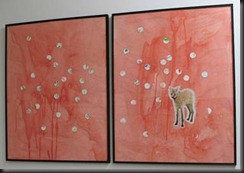
("Articulate Bodies"; 2011; watercolour, acrylic, graphite, pen and thread on paper, 2 x 22" x 30)
Photo courtesy Connie Morey

Detail:
Articulate Bodies
Photo courtesy Debora Alanna
Vectors of subjectification do not necessarily pass through the individual, which in reality appears to be something like a ‘terminal’ for processes that involve human groups, socio-economic ensembles, data-processing machines, etc. Therefore, interiority establishes itself at the crossroads of multiple components, each relatively autonomous in relation to the other, and, if need be, in open conflict.
(Guattari, 2008: 25)
[18]
Stitched to the work, a fox hovers in the midst of a spilled blood red wash with distinct marked spheres connected with lines as the middle ground.
Articulate Bodies holds the interconnected essence of what is eloquent and lucid, but impalpable. The fox is sutured to the reddish variable streaming wash, an uncomfortable taint. Morey creates a constellation of fox, astute presence crafted into ethereal dimensions, a correlation between what is familiar and inexplicable. The stain, a veneer of pervading memory, a semblance of evocation bleeds behind the spots, perhaps micro Felix Guattari terminals (quote above), sites drawn together to configure what can be articulated, bodies of penetration present and distinct without the need of the usual sensory faculties. If there is conflict, it is signified by the red background evocation. The lines connecting the differentiated circles with perforated surrounds, criss-cross the flushed expanse, and are oblivious to the animal presence, which demands our attention. Morey ensures that we are attentive to the fox existence facing the viewer. The fox becomes the representative of ecosophical wisdom that Arne Næss speaks about
: By an ecosophy I mean a philosophy of ecological harmony or equilibrium. A philosophy as a kind of sofia (or) wisdom, is openly normative, it contains both norms, rules, postulates, value priority announcements and hypotheses concerning the state of affairs in our universe. Wisdom is policy wisdom, prescription, not only scientific description and prediction. The details of an ecosophy will show many variations due to significant differences concerning not only the ‘facts’ of pollution, resources, population, etc. but also value priorities.
[19] Morey insists that although the universe/universal articulations she represents with the hubs of interconnected dots, the value of ecological priorities that the fox stance distinguishes as the a priori fact where the rest of our experience originates from - the suspended, interconnected widespread bodies of thinking, endeavours that inform and motivate, are our consciousness that depends on acknowledging the confounding fox as an intimate and ancient wisdom, is the prescription for future values.
 "Symbiophonia"; Pen on paper; 3 x 22" x 30"; 2013
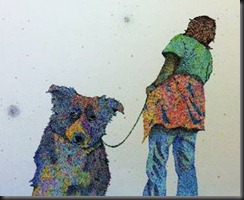 DETAIL Symbiophonia
Photos courtesy Connie Morey
If no one learns to sing you, song,
I do not mind at all: no one
Could sing you as I can.
~ Fourth Day: Conclusion. P. 299.
The Decameròn (Il Decameron, cognominato Prencipe Galeotto). 1351 or 1353 by Giovanni Boccaccio. Tr. by J. G. Nichols. Everyman’s Library. Alfred A. Knopf, 2009.
A natal sky, a cellular expanse has a human turned inward inspecting on its edge, listening to the marcro cellscape constitution made available by Morey, while a dog inspects us. Human and canine are also composed of highly differentiated cells. Morey devises the associations possible with symbiotic relationships, the interdependence that impacts all living entities. Morey crafts the resonance of these symbiotic relationships, which may be complementary, mutually beneficial. Morey concentrates on optimistic, ideal symbiosis, especially from a human perspective that benefit species involved but symbiosis can be parasitism, where one species feeds off another, the host and generally diminishes because of the other’s thriving, commensalism, where only one species benefits, and the other usually is unaffected, amensalism where one species is harmed or inhibited and the other is unaffected. Natural entails of all these types of symbiotic relational constructs. Morey shows symbiosis generatively, involving positivity. Her cellular matters are enlivened colours speaking through the scene and are within the work’s figure turned away and inward, within the tethered animal looking outward, at us. What Morey succeeds in revealing is what the metaphysical can intone and what we can perceive as a type of unique symbiosis, our irrefutably beneficial animal-human relationship, animal and human connectivity and our longing for and draw towards nature that is sound affirmation - encouraging, is creatively synergistic, restorative. If the animal was wild, not tethered in time to its human, this would be a different sounding scenario. The human would not be casually listening to benefitting causality. The androgynous human is alone tied to the dog, the dog’s attachment. The two seem to be an insulated existence. Morey dots in her cellular vista, splotches of the indefinable in the cosmos, can only be understood metaphysically.
The human may seem to intently listen independently; the dog may seem to hear what we thoughts we are thinking, though we think they are our own, our own song. What we internalize, we sonically embody, hear, feel, our consciousness is merely more spots cohabitating a symbiotic exchange, cellular interconnections on the verge of the universe. Morey articulates those sounds of the spheres tacitly.
Connie Michele Morey
ba_ble: inarticulations on human-animal relations
Xchanges Gallery
Victoria BC
1st February – 24 February 2013
Part 2 – Review by Debora Alanna
[1] http://pepperell.blogspot.ca/
[2] Originally published in
Flash Art International, Milan, Italy, January /
February 1993.
[3] http://ontology.buffalo.edu/
[4] Merleau-Ponty, Maurice. “The Primacy of Perception and Its Philosophical Consequences,” from
The Primacy of Perception and Other Essays, pp. 121-127. Evanston, IL: Northwestern University Press, 1964. Translation ©1964 by Northwestern University Press.
4 "...While we dawdle, our lives pass swiftly. The proverb has been traced back in English to 1386 in Chaucer's 'Prologue to the Clerk's Tale.' The earliest American appearance in print is 1710 in 'Mayflower Descendant.' The idea was first expressed by Virgil (70-19 B.C.), who wrote in the 'Aeneid': Fugit inreparabile tempus' (Time is flying never to return)..." [5] From "
Random House Dictionary of Popular Proverbs and Sayings" by Gregory Y. Titelman.
[6] http://www.scribd.com/doc/49161532/The-conference-of-the-birds
[7] Takahashi M Toward a culturally inclusive understanding of wisdom: historical roots in the East and West.
Int J Aging Hum Dev 2000;51 (3) 217- 230
[8] Webster's Encyclopedic Dictionary of the English Language. New York, NY Lexicon Publications1990;
[9] Jeste DVVahia I Comparison of the conceptualization of wisdom in ancient Indian literature with modern views: focus on the Bhagavad Gita.
Psychiatry 2008;71 (3) 197- 209
PubMed
[10] Takahashi MOverton WF Cultural foundations of wisdom: an integrated developmental approach. Sternberg RJJordan J
A Handbook of Wisdom Psychological Perspectives.New York, NY Cambridge University Press2005;32- 60
[11] Brugman GM
Wisdom and Aging. Amsterdam, Netherlands Elsevier2006;
[12] Birren JESvensson CM Wisdom in history. Sternberg RJJordan J
A Handbook of Wisdom Psychological Perspectives. New York, NY Cambridge University Press2005;3- 31
[13] Ardelt M Wisdom as expert knowledge system: a critical review of a contemporary operationalization of an ancient concept.
Hum Dev 2004;47 (5) 257- 285
[14] Excerpts from The Dinner Part: A Symbol of Our Heritage (1979). Copyright © Judy Chicago.
[15] http://www.conniemorey.com/taxonaphonia.html
[16] http://www.conniemorey.com/following.html
[17] http://www.gutenberg.org/catalog/world/readfile?fk_files=3248835&pageno=3
[18] Guattari, Felix.
The Three Ecologies, trans. Ian Pindar and Paul Sutton (London: Continuum, 2008). - See more at:
http://eighteen.fibreculturejournal.org/2011/10/09/fcj-121-transversalising-the-ecological-turn-four-components-of-felix-guattari%E2%80%99s-ecosophical-perspective/#sthash.5C4wm7Mr.50ngPAZg.dpuf
[19] http://www.ecospherics.net/pages/DrengEcophil.html